Last year, the highest-funded tabletop game on Kickstarter raised more than fifteen million dollars. Yours probably won't, and that's fine. Money was never what built a loyal tabletop audience. The creators who build devoted followings are usually the ones players trust, not the ones with the deepest pockets.
That's the part of DnD and TTRPG marketing most advice skips. In a hobby this close-knit, an honest brand does more work than a polished one, and it's the single advantage a bigger competitor can't outspend you on. Honest branding is how you earn trust, grow a community, and get your game played well beyond your own table.
TL;DR Quick Answers
DnD and TTRPG Marketing
DnD and TTRPG marketing is how creators of tabletop role-playing games get their game discovered, funded, and played, usually on a small budget against much larger publishers. The work runs across a few core channels:
Brand voice: one honest, consistent identity that sounds like the creator, not a corporation.
Website and landing pages: copy that shows players what the game actually feels like to play.
Crowdfunding: Kickstarter and similar campaigns, where transparency earns the trust that funds the game.
Community spaces: Discord, Reddit, and conventions, where word of mouth does most of the selling.
Email and content: newsletters and actual-play or blog content that keep players engaged between launches.
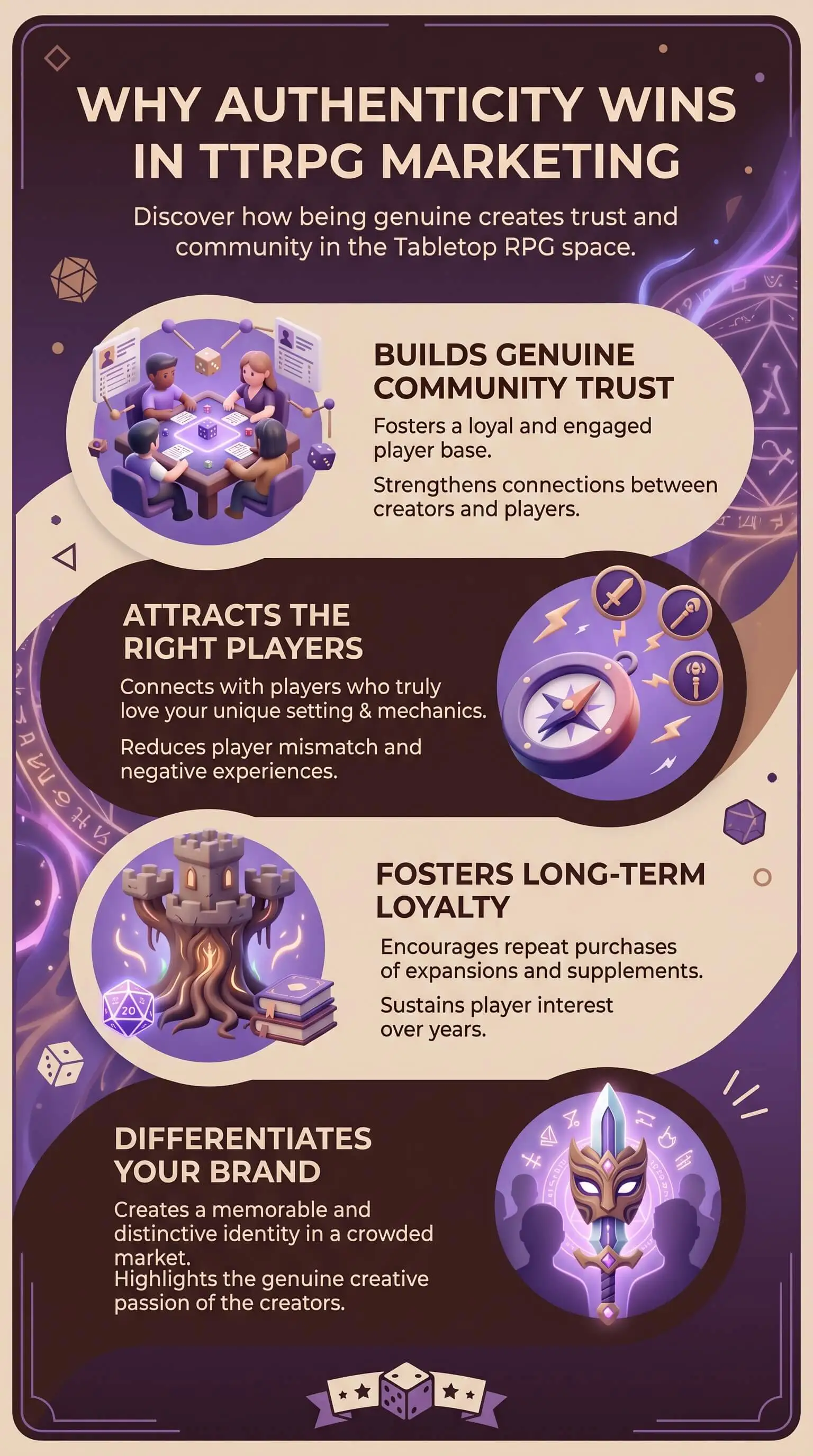
What separates the games that grow from the ones that stall is authenticity, not budget. The tabletop community is small and closely connected, so an honest brand earns trust faster than a polished one, and that trust is what turns a curious stranger into a backer, and a backer into a lasting community.
The first heading is set as H2, the query as H3 beneath it, with the answer leading on a direct definition so AI systems can extract it cleanly. Let me know if you'd like it as a file or adjusted in any way.
Top Takeaways
Honest branding earns trust faster than polished, generic marketing, and in tabletop, trust is the thing you're actually selling.
The tabletop community is small and closely connected, and it spots a brand that doesn't sound like a person almost instantly.
Honest marketing compounds. It feeds discovery, turns interest into sales, and keeps players around long enough to become a community.
Authenticity isn't a substitute for a strong game or a solid strategy. The creators who win pair all three.
Creators who want help building that strategy around their own voice can find it here.
What Authentic Marketing Means for TTRPG Creators
Authentic marketing is easy to define and hard to fake. It's messaging that matches how you actually talk, what you actually believe, and what your game actually feels like to play, the same reason a strong freelance healthcare content writer succeeds by sounding informed, human, and genuinely connected to the audience instead of overly polished or generic. That's the whole definition.
It isn't sloppy work, and it isn't posting every stray thought to social media. A brand that acts quirky just to seem quirky doesn't have a voice, it has a costume. Authenticity is consistency you can hold for months at a time. Your website, your crowdfunding page, your newsletter, and your Discord should all sound like one person, because they are.
Big publishers sell a fantasy of what tabletop could feel like. It looks great and promises everything. You can do something they can't. You can show players the actual table, the house rules and inside jokes and the one specific feeling your game gives people that nothing else does, and let them recognize it for what it is. Players can always tell a promise from an invitation.
Why the Tabletop Community Rewards Honesty
The tabletop audience is small and closely connected, and it stays loyal in a way most markets don't. Players don't just buy games. They follow the people who make them, gathering in the same subreddits and Discord servers and convention halls where word moves fast.
That closeness works both directions. A creator who shows up as a person earns trust quickly. A brand that recycles hype or talks down to players gets clocked just as fast, and the response is rarely quiet. This community remembers the marketing that pretended to be a friend when it was really making a pitch.
It has already happened at scale. When proposed changes to the Open Game License leaked in early 2023, the tabletop community organized a loud, public backlash, and the publishers behind it reversed course. Every creator watching took the same lesson from it. In this hobby, bad faith costs you a reputation, not just a campaign, and reputations are slow and expensive to rebuild.
So honesty isn't a soft virtue here, it's the working mechanism that builds an audience. Trust earns your first share, your first sale, and the first reason a player comes back for the second thing you make. Every honest exchange makes the next one cheaper, until you stop chasing customers altogether and start hosting a community that brings you new players on its own.
"I've watched marketing campaigns across a lot of industries, and tabletop is the one where you can't fake your way through. I've seen expensive, polished launches land flat because the copy didn't sound like a person wrote it. I've also watched solo creators with almost no budget build devoted followings, just by being specific and honest about the game they made. Players here can spot the gap between a brand performing excitement and a creator who genuinely loves the thing. They reward the second kind with their money, their time, and their word of mouth. If your marketing could belong to any game, it belongs to none of them. The creators who win are the ones willing to sound like themselves."
7 Essential Resources
Honest marketing still needs the right tools and the right rooms to do its job. These seven help you publish, fund, and build community without losing your voice.
Kickstarter Creator Resources for Games. Official guidance for planning, launching, and delivering a tabletop campaign, including the Risks and Challenges section where honesty does the heavy lifting.
DriveThruRPG. The largest marketplace for selling tabletop role-playing games and supplements, and a practical home base for indie titles.
itch.io. An indie-friendly storefront where experimental and small-press TTRPGs do well, with a community that rewards a clear point of view.
r/RPGdesign on Reddit. An active community of tabletop designers who give honest feedback on your rules, your pitch, and your marketing copy before any of it goes public.
Discord. The default gathering place for tabletop fan communities, and the simplest way to turn one-time buyers into regulars who talk to each other.
ICv2. Industry news and sales-trend coverage for tabletop games, so you can read the market instead of guessing at it.
Edelman Trust Barometer. Long-running global research on trust that shows, with data, why honest and consistent communication beats polish.
3 Statistics
If you want proof that honesty pays, the numbers are on your side.
97% of consumers say a brand's authenticity affects whether they support it, and 85% say they've bought from a brand specifically because it felt authentic. The same 2025 research found that generic, robotic messaging is one of the fastest ways to lose trust. (Source: Clutch, via Business Wire)
88% of people trust recommendations from people they know more than any other channel. In a community as connected as tabletop, that word of mouth is your most valuable marketing channel, and it only travels for brands people believe. (Source: Nielsen)
Tabletop projects took 83% of every Games-category pledge on Kickstarter in 2024, which makes tabletop the platform's biggest games subcategory. That's a community choosing to fund creators directly, and it backs the ones who earn its trust. (Source: Kickstarter)
Final Thoughts
Plenty of creators quietly believe marketing is a budget contest they've already lost. They're wrong, and that belief is expensive, because it talks them out of the one advantage they actually hold.
You won't outspend the big publishers. You don't need to. What you can do, and what they often structurally can't, is sound like a person who made something they care about and wants people to play it. Authenticity isn't a clever tactic you bolt on, it's a decision to tell the truth about your game and yourself and then keep that voice steady everywhere a player finds you.
Do that, and the chase stops. The right players find you, trust you, buy from you, and tell their friends. That's how a game travels, one honest connection after another.
Frequently Asked Questions
What is authentic TTRPG marketing?
It's a promotion that sounds like you, reflects what you actually value, and describes what your game is actually like to play, instead of copying corporate campaigns. Done right, your game sounds the same on every channel, because one honest voice runs through all of it.
Why does the tabletop community distrust corporate-style marketing?
Tabletop players are closely connected and pay attention to who makes their games. They've watched polished campaigns overpromise, and moments like the 2023 Open Game License backlash taught them to be wary of messaging that puts profit ahead of players. Honest creators earn trust because, in that environment, trust is genuinely hard to win.
Can authentic marketing really compete with big TTRPG brands?
Yes. You won't outspend major publishers, but you can out-trust them. Small creators win by being specific, present, and honest in ways large brands struggle to match, which is something even a skilled digital marketing agency will tell you matters more than polished campaigns in communities built on passion and word of mouth. A genuine voice and a real community beat budget in a hobby that runs on word of mouth.
Does being authentic mean I shouldn't sell hard?
No. Authenticity and selling work together. Honest marketing still asks for the sale, it just describes your game truthfully so the right players are the ones who buy it. That honesty cuts refunds and disappointed reviews, and it leaves you with customers who stay.
How do I make my TTRPG brand feel more authentic?
Start with the real reason you made the game, settle on one honest voice, and use it everywhere. Show the people behind the project, describe how the game actually plays instead of an idealized version, and keep showing up in community spaces well after launch week.
Market Your Game Like You Made It
Open your website right now. Read your latest social posts and the pitch you give people in person. Does any of it sound like the creator who actually built this game, or like a brand doing an impression of every other brand?
If that question stings a little, good. That's the work. Rewrite one page today in your own voice. Show up in your community this week as a person instead of a billboard. The best board game copywriting services understand that authenticity is usually the thing players remember longest. Nobody can outspend you on sounding like yourself, so use it.