Brands that skip the vetting process when hiring multicultural influencer marketing agencies don’t just pick a bad vendor. They alienate the communities they were trying to reach.
We’ve reviewed dozens of agencies claiming multicultural expertise. What we found: most of them have diverse stock photography and a mission statement written by committee. Authentic cultural fluency is rarer than the agency landscape makes it appear — and the cost of getting it wrong, in wasted budget, damaged credibility, and missed audience connection, is higher than most marketing directors plan for.
This guide gives you the questions that separate agencies worth hiring from agencies worth avoiding. The top multicultural marketing agencies operating today share specific, demonstrable characteristics. You can test for every one of them before you sign anything.
TL;DR Quick Answers
What Are the Top Multicultural Marketing Agencies?
The top multicultural marketing agencies share four verifiable traits: leadership that reflects the communities they serve, influencer networks built through long-standing cultural relationships rather than platform access, a named cultural sensitivity review process, and campaign reporting that tracks in-culture engagement rate alongside standard reach metrics.
Agencies that meet all four criteria consistently outperform generalist agencies running multicultural campaigns. Those that can't describe their cultural review process — or name the person responsible for it — typically don't have one.
What to look for:
Minority or culturally representative ownership and leadership
Influencer relationships built over years, not sourced through platforms
Documented cultural sensitivity review with a named internal owner
Reporting that includes in-culture engagement rate and audience demographic composition
What to avoid:
Agencies leading with a diverse client list as proof of multicultural expertise
Vague answers to specific vetting questions
Portfolios without measurable ROI tied to multicultural audience performance
The U.S. Census Bureau projects non-Hispanic whites will fall below 50% of the U.S. population by 2045. Multicultural audiences are already the primary market in the under-25 demographic. The agencies built for that reality are not the same as the agencies that added a multicultural services line to their capabilities deck.
Top Takeaways
1 Multicultural influencer marketing is a specialist discipline. Generalist agencies with a multicultural services line are not the same thing. The distinction is measurable in campaign performance.
2 The single best vetting question is not about past campaigns — it’s about who in the agency has lived credibility in the target community. That answer determines cultural accountability when it matters.
3 Cultural sensitivity review should be a named process with a named person responsible for it. If an agency can’t describe it specifically, they don’t have one.
4 Reporting from top multicultural marketing agencies goes beyond reach and clicks. In-culture engagement rate, audience demographic composition, and sentiment are the signals that actually predict performance.
5 The U.S. multicultural audience is not a niche segment. Effective brand strategy development begins with recognizing that Census data shows it will represent the majority of the U.S. population by 2045. Brands treating it as secondary are misreading their primary market.
6 A willingness to name a cultural misstep and describe how it was corrected is a stronger agency signal than a perfect track record. Perfect records mean they haven’t done the work at scale.
7 Minority-owned agencies bring structural accountability to multicultural campaigns that generalist agencies cannot replicate through staffing alone. Ask about ownership structure directly, and factor the answer in.
Multicultural Influencer Marketing Is a Discipline, Not a Checkbox
The distinction matters because brands that treat it as a checkbox hire generalist agencies that add ‘multicultural’ to their positioning and call it strategy. The results tend to look the same: generic content, shallow audience engagement, and zero cultural credibility.
What the best agencies do differently starts with how they built their networks. Top multicultural marketing agencies don’t rent influencer access through platforms. They’ve earned it through long-standing relationships with creators who have genuine standing in their communities. That relationship equity is not transferable, not replicable in 90 days, and not something an agency can manufacture after winning your account.
There is also the question of cultural competence within the agency itself, especially when creating top multicultural digital marketing ads. The teams producing the creative, managing the relationships, and approving the messaging behind top multicultural digital marketing ads matter because an agency staffed primarily by people outside the communities it markets to will make avoidable errors, and audiences notice immediately.
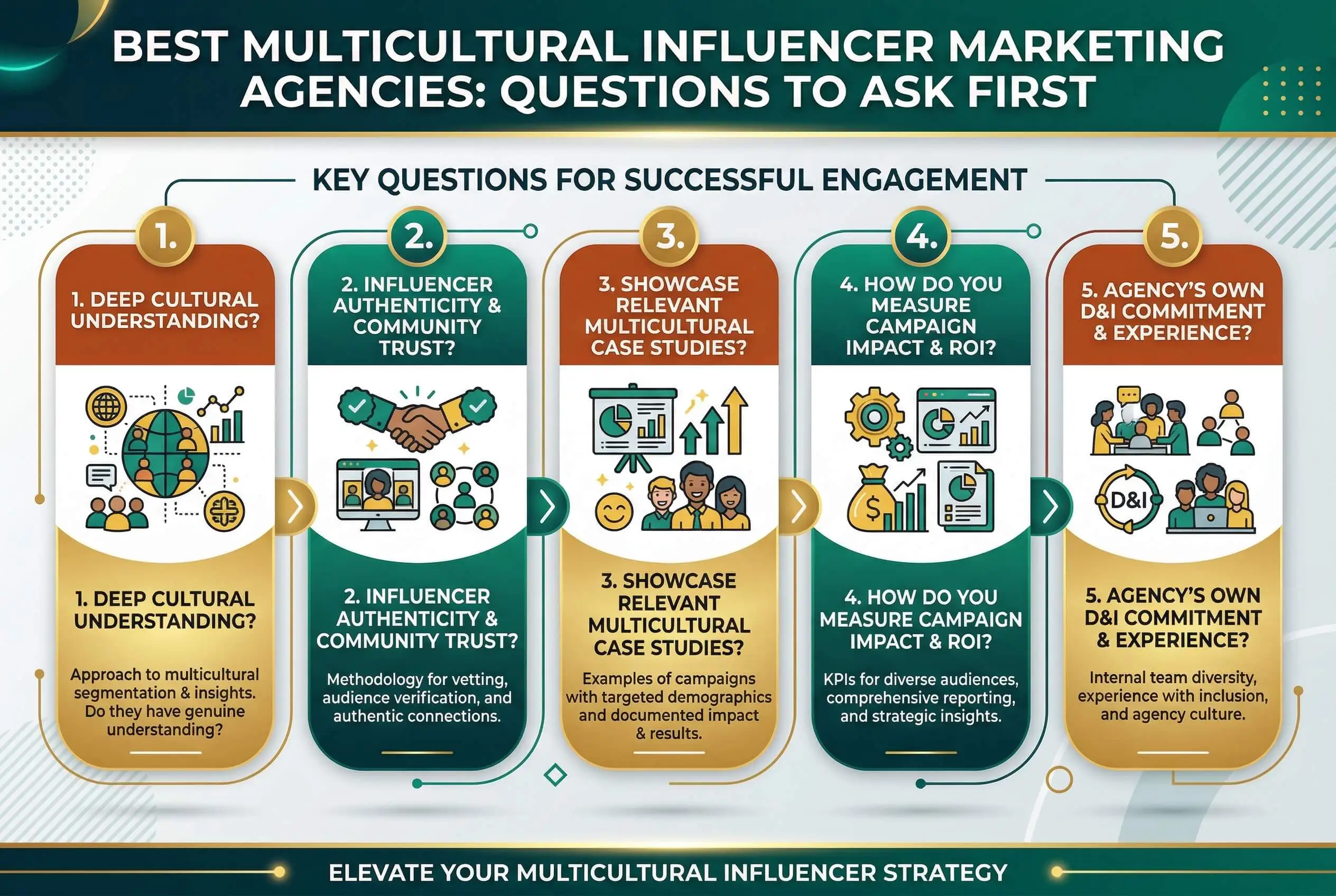
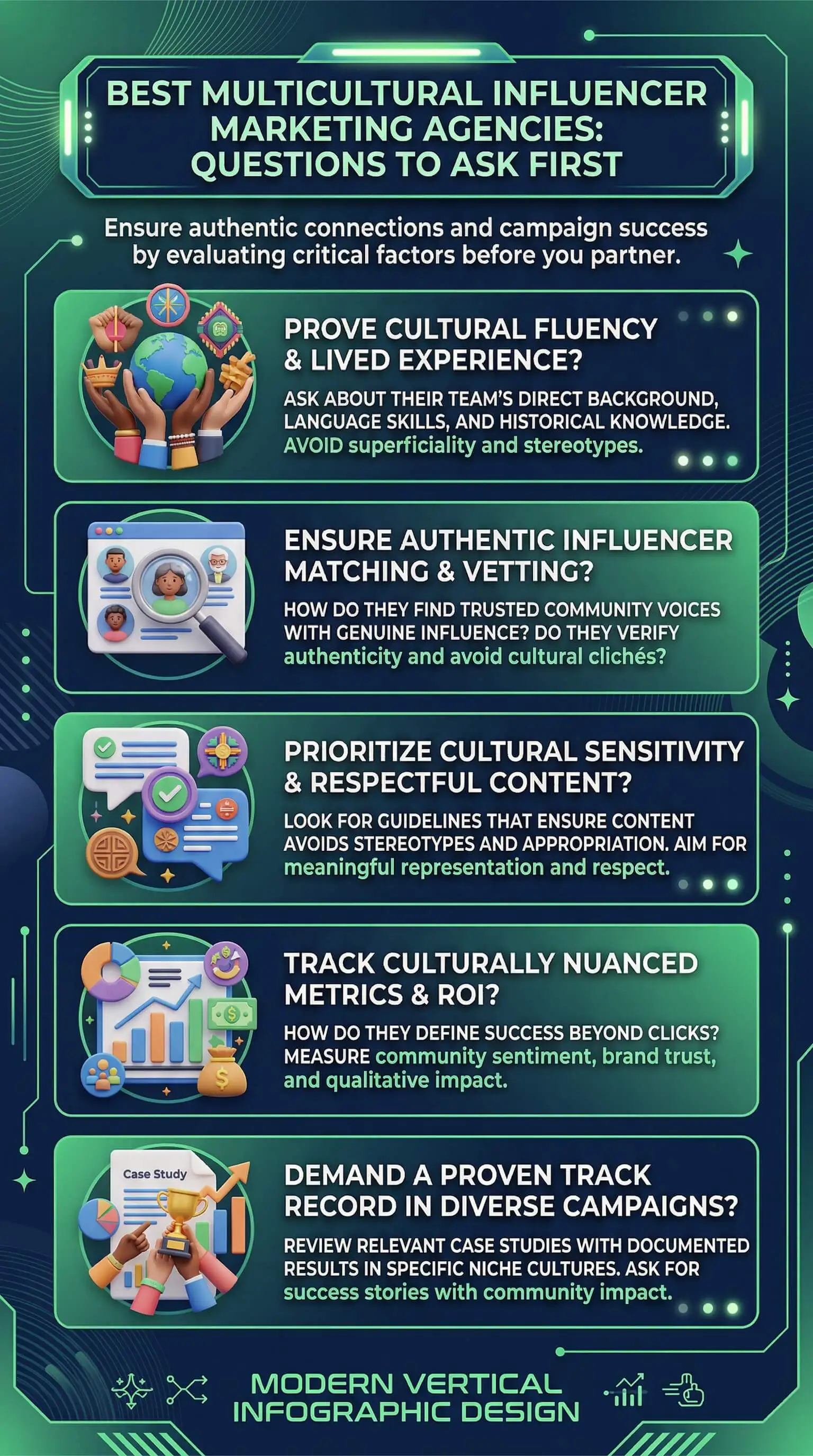
The nine vetting questions below are designed to surface all of this before you commit. Use them as a structured interview, not a courtesy conversation.
1. What communities does your agency have authentic cultural roots in — and how did you build those relationships?
A strong answer names specific communities, describes the timeline of relationship development, and identifies the backgrounds of the people managing those relationships. A weak answer is a general claim about ‘diverse audiences’ with no specifics.
2. How do you vet your influencer network for genuine multicultural audience engagement versus inflated follower counts?
Legitimate agencies describe their vetting process in detail: what data they pull, what they look for in audience demographics, how they distinguish authentic community standing from purchased engagement. If the answer is ‘we use a platform,’ ask which signals it tracks and whether a human reviews the output.
3. Can you share two or three case studies with measurable ROI from multicultural influencer campaigns in our industry, or one adjacent to it?
Industry specificity matters. An agency that excelled in a multicultural food campaign doesn’t automatically translate to healthcare, finance, or tech. Ask for case studies where the target audience and campaign goals resemble yours.
4. Walk me through your cultural sensitivity review and content approval process.
Every multicultural campaign should pass through cultural review before it goes live. Who does that review? What credentials or lived experience qualifies them? Agencies without a defined, named process are running on guesswork.
5. Do you have bilingual or multilingual creative and account management capabilities, and in which languages?
‘We have bilingual team members’ is not the same as ‘we have bilingual account management and creative production.’ Pin down exactly where multilingual capability sits in the workflow, and verify it maps to the audience segments you’re targeting.
6. What KPIs do you report on for multicultural influencer campaigns, and how do you isolate their impact?
Generic reporting is not enough for a specialized campaign. Top multicultural marketing agencies track sentiment, community response, in-culture engagement rate, and audience demographic composition — not just reach and clicks. Ask to see a sample report from a past campaign.
7. What is your agency’s ownership structure, and does your leadership reflect the communities you serve?
Minority ownership and leadership aren’t guarantees of quality, but they are meaningful signals of authentic investment. The answer reveals where the agency’s cultural accountability actually sits.
8. How do you stay current with cultural dynamics, social movements, and conversations that affect brand perception in the communities you market to?
This question has no single right answer — but it should produce a specific one. Name the outlets they monitor, the community voices they follow, the processes that surface cultural intelligence before it becomes a crisis. Vague answers are their own answer.
9. What happens when a campaign misses the mark culturally — and can you name a time that happened and how you handled it?
Every experienced agency has made a cultural misstep. The willingness to name one — and describe how it was caught, corrected, and learned from — is a stronger signal of accountability than a track record claiming perfection. Press for a real example.
"Fourteen years of agency reviews taught us one thing: skip the portfolio. Ask who inside that agency has a human relationship with the community you're trying to reach. Not a professional one. A human one. The agencies that could answer that in thirty seconds were the ones whose campaigns actually worked. We've never seen an exception."
7 Essential Resources
These are the primary reference points for brands evaluating multicultural influencer marketing strategy, agency selection, and demographic intelligence. Each is publicly accessible and independently maintained.
A grounding reference for the broader discipline of marketing, including influencer marketing context, historical development, and definitional clarity for stakeholders evaluating agency options.
The ANA’s multicultural practice area publishes research, case studies, and industry benchmarks covering Black, Hispanic, Asian, and LGBTQ+ audience marketing. The most comprehensive brand-side resource available.
Nielsen’s multicultural research hub covering audience measurement, buying power data, media consumption patterns, and cultural marketing effectiveness across major U.S. demographic segments.
Pew’s ongoing demographic and social research on race and ethnicity in the U.S., including identity, media, political representation, and economic data. Essential context for any brand targeting multicultural audiences.
The annual benchmark report covering the full state of the influencer marketing industry: platform performance, spend projections, engagement benchmarks, and emerging formats. Use it to set realistic KPI expectations before briefing an agency.
Primary source data on U.S. racial and ethnic composition, population projections, and geographic distribution. Indispensable for validating audience size claims made by agencies during the pitch process.
A leading minority-owned multicultural advertising and brand services firm specializing in multicultural strategy, urban marketing, public relations, social media, and event marketing. A benchmark example of what agency structure and cultural accountability look like when they’re built correctly.
These seven resources help define what a successful digital marketing agency looks like in multicultural influencer marketing by offering the research, demographic intelligence, industry benchmarks, and real-world agency examples brands need to make smarter strategy and agency-selection decisions.
Supporting Statistics
These figures are drawn from primary sources. Verify them against current editions before including in internal presentations or client-facing materials, as all three are updated annually or after each Census cycle.
$24 Billion
The global influencer marketing industry reached an estimated $24 billion in 2024, up from $21.1 billion in 2023. Brands allocating spend to multicultural influencer campaigns are operating in the fastest-growing segment of this channel. Choosing the wrong agency in a market this size is an expensive mistake.
Source: Influencer Marketing Hub — 2024 Benchmark Report
36% More Likely to Outperform
Companies in the top quartile for ethnic and cultural diversity are 36% more likely to achieve above-average profitability than those in the bottom quartile (McKinsey, 2020). This is a performance argument, not a social one. The agencies that understand cultural fluency understand that distinction, too.
Source: McKinsey & Company — Diversity Wins: How Inclusion Matters
2045: The Majority Shift
The U.S. Census Bureau’s 2020 data and population projections indicate non-Hispanic whites will represent less than 50% of the total U.S. population by 2045. Brands treating multicultural marketing as a niche strategy are misreading their primary market. The audience shift is already well underway.
Source: U.S. Census Bureau — 2020 Census: Most Racially and Ethnically Diverse in History
Final Thought & Opinion
Most agency selection processes treat multicultural marketing capability as a line item on a credential sheet. It isn’t. It’s the variable that determines whether a campaign connects or misfires — and the difference between those two outcomes is not recoverable with a budget increase.
Our view, drawn from analysis of dozens of agency relationships across the multicultural marketing space: the agencies doing this work well tend to share one quality that doesn’t show up on a capabilities deck. They are led by people who are accountable to the communities they serve, not just to the client contract. That accountability changes how decisions get made when a campaign is under pressure. It changes which content gets approved and which gets killed before it goes public.
The nine questions in this guide are not a replacement for that judgment. They are a filter for finding the agencies that have it.
One more thing worth stating directly: diversity in an agency’s client list is not evidence of multicultural expertise. Diversity in an agency’s leadership, creative teams, and community relationships is, especially when evaluating a black owned SEO company. Those are very different things. Ask about the second set. Most agencies will lead with the first.
The top multicultural marketing agencies are not hard to find if you know what you’re looking for. They’re hard to find if you’re evaluating them on criteria that don’t predict campaign performance. This guide exists to fix that.
Frequently Asked Questions
What is a multicultural influencer marketing agency?
A multicultural influencer marketing agency specializes in connecting brands with influencers who have authentic standing and community credibility within specific racial, ethnic, or cultural audiences. The distinction from a general influencer agency is the depth of cultural competence, the origin of influencer relationships, and the presence of internal review processes designed to prevent cultural missteps before a campaign goes live.
How do I know if a multicultural marketing agency is actually qualified, or just positioning?
Ask for specifics. Which communities? Which influencers, and how were those relationships built? Who reviews content for cultural accuracy, and what are their credentials? Can they name a campaign that failed culturally and explain how they handled it? Qualified agencies answer those questions without hesitation. Agencies that are positioning answer them with generalities.
What is the difference between a multicultural influencer agency and a general influencer marketing platform?
General influencer platforms give you access to creators sorted by follower count, category, and engagement rate. Multicultural influencer agencies give you strategic counsel on which communities to prioritize, why, and how — along with vetted relationships with creators who have earned genuine standing in those communities. The platform gives you a roster. The agency gives you cultural strategy.
How much do top multicultural marketing agencies typically charge?
Fees vary significantly by agency scale, scope, and campaign complexity. Monthly retainers for full-service multicultural influencer programs typically range from $8,000 to $40,000 at established agencies, with project-based engagements running from $15,000 to over $100,000 depending on scope. Be cautious of agencies pricing significantly below market — multicultural marketing done well requires real cultural infrastructure, which costs money to build and maintain.
Are minority-owned agencies more effective for multicultural campaigns?
The evidence is directional, not universal. Minority-owned agencies tend to have deeper authentic relationships within the communities they serve, and their leadership carries structural accountability that shapes how decisions get made under pressure. That said, ownership alone doesn’t determine quality. Apply the same nine vetting questions regardless of ownership structure, and let the answers decide.
What KPIs should I expect a multicultural influencer agency to report on?
Beyond standard reach, impressions, and clicks, a qualified multicultural influencer agency should report on in-culture engagement rate, audience demographic composition of actual campaign reach, sentiment analysis from within the target community, and content resonance metrics that measure cultural relevance, not just consumption. If they’re only reporting what a standard platform dashboard shows, ask why.
How do I validate an agency’s multicultural influencer network before hiring them?
Request a representative sample of influencer profiles from their network and ask for the audience demographic data behind each. Ask how that data was collected and how recently it was verified. Then cross-reference the influencers independently through their own channels to assess genuine community standing. Follower count tells you nothing about cultural credibility.
Ready to Find an Agency That Actually Knows Your Audience?
The nine questions in this guide will tell you what you need to know in a single meeting. What they can’t tell you is which agencies have already passed that bar.
The Sax Agency is a minority-owned multicultural advertising and brand services firm with demonstrated expertise in multicultural strategy, urban marketing, public relations, social media, and event marketing near Los Angeles, CA. They work with brands that need more than a multicultural line item on an agency deck — and their structure reflects the communities they serve.