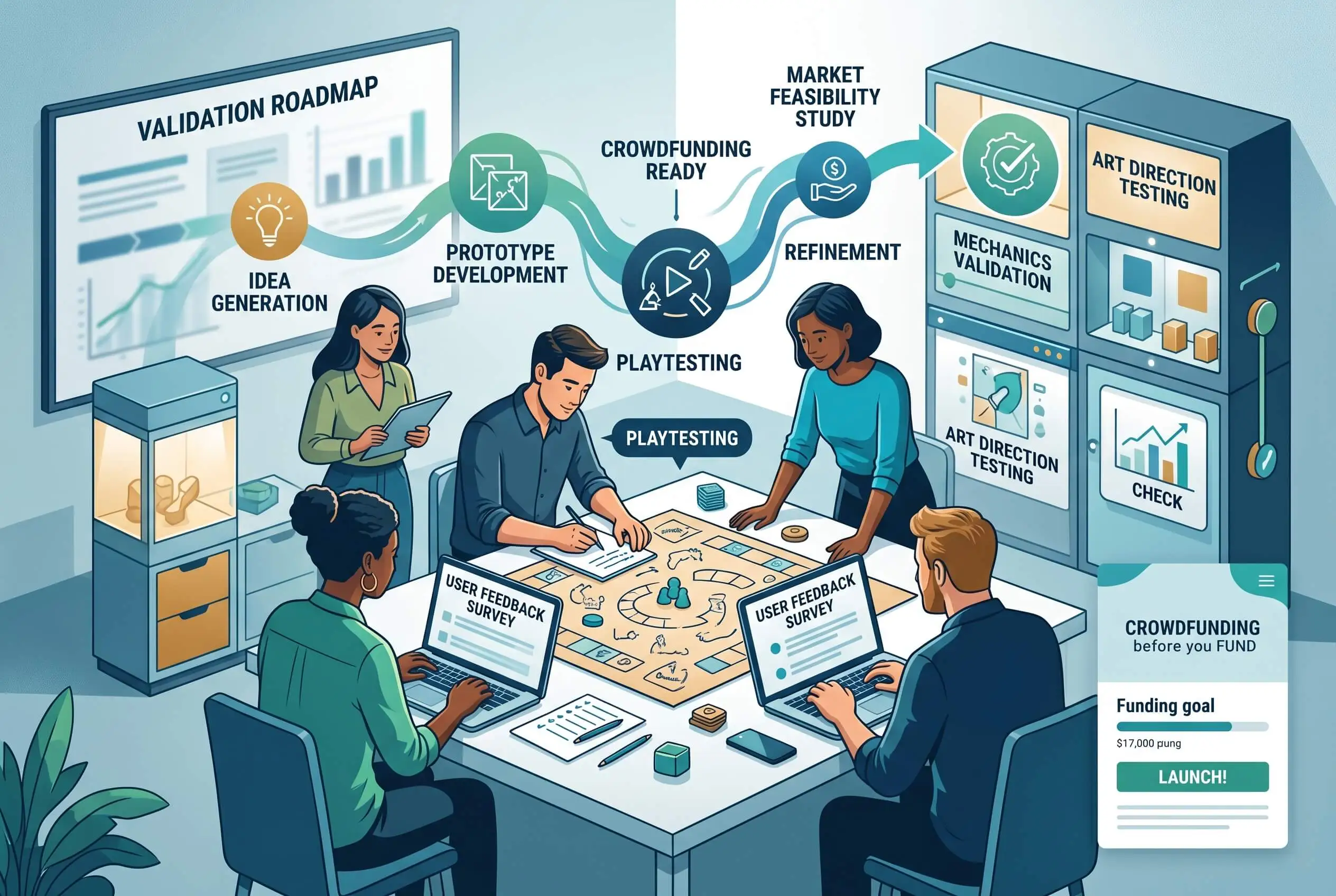
Three weeks out from a Kickstarter, an experienced creator can usually predict whether the campaign will be funded. The signals are already sitting on the dashboard: how many people followed the pre-launch page, whether the blind playtests held finished without players quitting, how the demo line ran at the last convention. Pre-launch validation is the discipline of reading those signals honestly before launch day, instead of hoping for the best on launch day. It's the part of a board game crowdfunding strategy that gives creators the confidence to refine their campaign early, strengthen weak spots before launch, and dramatically improve the odds of funding successfully in week one instead of stalling out by week three.
TL;DR Quick Answers
board game crowdfunding strategy
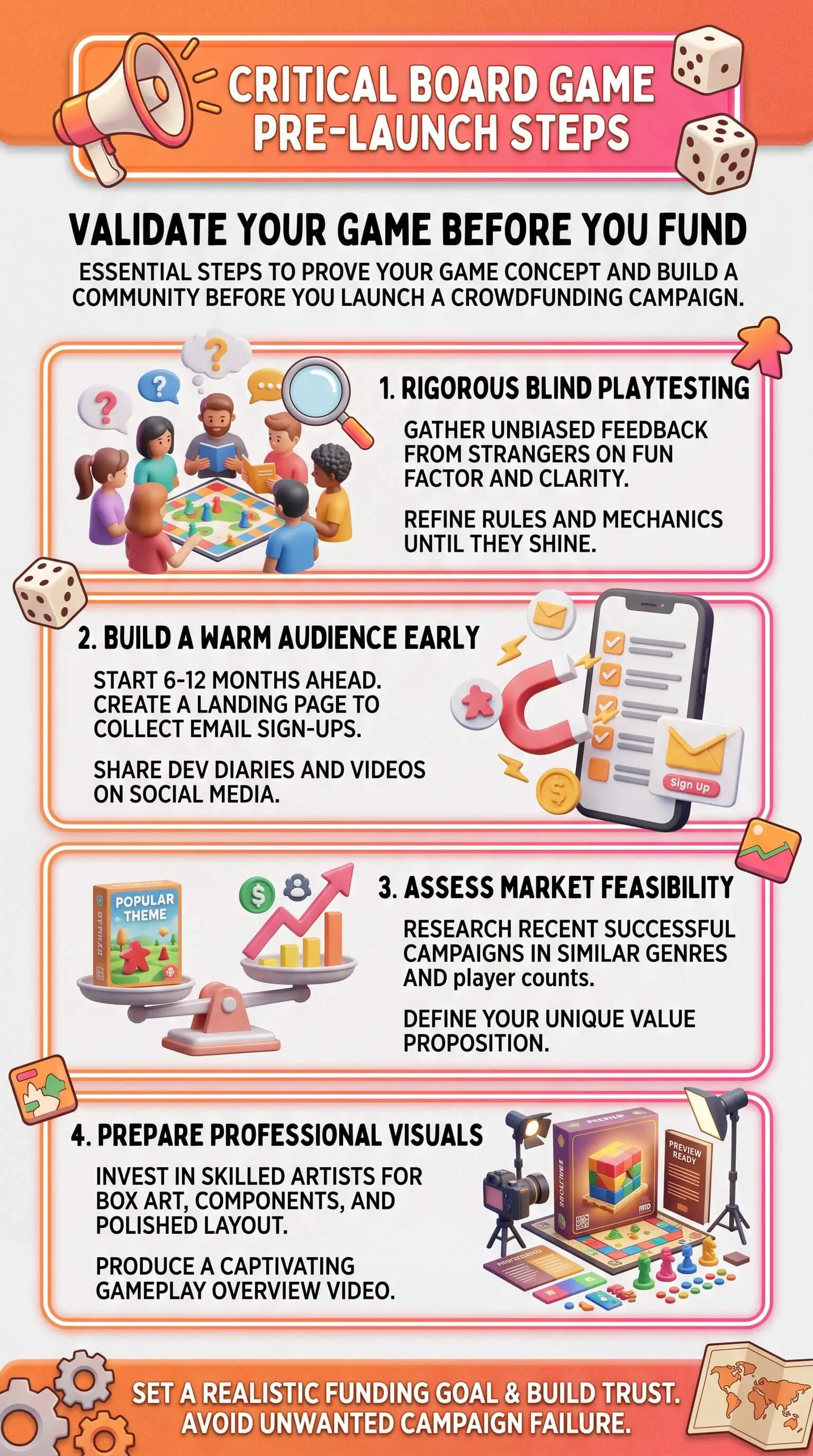
A board game crowdfunding strategy is the pre-launch work that confirms paying demand exists before a campaign goes live, then converts that demand into day-one backers. The full sequence takes six to twelve months and covers four critical components:
Blind playtesting with strangers, not just the design group, to confirm the rulebook teaches the game on its own
A pre-launch landing page and a Kickstarter "Notify on Launch" page running in parallel to collect emails and platform followers
Convention demos at events like Gen Con, PAX Unplugged, or a regional convention to measure unprompted backer interest
Pledge math built backwards from per-backer margin to confirm the validated demand level clears the funding goal with headroom
The campaigns that fund cleanly almost always finish the validation work months before they pressed the launch button.
Top Takeaways
Closed playtesting protects you from rule errors, but only blind playtesting tells you whether strangers will actually finish the game.
Whether the project is a roll-and-write, a heavy euro, a deck-builder, or a party board game, the validation sequence stays the same. Only the test audiences and demo settings change.
Kickstarter pre-launch followers are a stronger demand signal than email signups, because the platform requires an account before someone can follow a project.
Build the campaign budget backwards from the final per-backer margin. If the demand you've validated doesn't clear that budget, you haven't validated enough.
Treat unprompted backer questions about price, ship date, and stretch goals as the real signal from any demo or community thread. Polite encouragement is friendly noise.
The Validation Sequence That Decides Whether You're Ready to Launch
Validation works as a stack of tests run in sequence, each one answering a question the previous test couldn't. Skip a layer and the unanswered question rides straight into the campaign, where it usually surfaces as a flat funding graph around day three.
Start With Closed Playtesting, But Don't Trust It
Closed playtesting means handing your prototype to friends, family, and the local design group: people who already know you. It catches component counts that don't add up, broken rule edges, and turns that drag past the fun ceiling. What it cannot do is tell you whether a stranger will pay to play the game, especially once you begin real DnD and TTRPG marketing outside your existing circle. People who love you will love your game a little more than the market does, every time, which means closed playtesting earns its place as quality control but leaves the real demand question wide open.
Move to Blind Playtesting as Fast as Possible
Blind playtesting means shipping the prototype and rulebook to people you've never met, then watching from a distance while they try to learn the game without you in the room. This is the single highest-value validation step in the entire process. A rulebook that can't teach the game on its own is still a manuscript, and shipping a manuscript to twelve hundred backers is the kind of mistake that ends a designer's reputation before it really starts. Run at least three to five blind tests with separate groups before locking a launch date. If two of those groups quit halfway through, the validation has failed, and that information is worth more than every positive playtest you ever ran with the people you know.
Collect Real Demand Signals Through a Pre-Launch Page
Once the game holds up to blind playtesting, the next question is whether anyone will actually pay for it. The clearest way to measure that is to run two pre-launch assets in parallel: a landing page that collects emails and a Kickstarter "Notify on Launch" page that collects platform followers. The two assets aren't interchangeable. Email signups cost the visitor nothing and commit them to nothing, which makes them the weaker signal of the two. Kickstarter followers count for more because the platform requires an account to follow a project, meaning the follower has already shopped Kickstarter before and is statistically more likely to convert when the campaign goes live. Watch both numbers, weigh the follower count more heavily, and treat the email list as supporting evidence rather than the primary indicator.
Pressure-Test Demand at Conventions and in Online Communities
Conventions give you something a landing page never will: live reactions from people who didn't choose to find you. Gen Con, PAX Unplugged, Origins, and Essen Spiel are the largest of these, though a regional convention with three hundred attendees can produce useful data as long as you actually demo the game and watch how strangers respond in the first three minutes. Track the number of strangers who ask, without prompting, where they can back the project. That's the real signal, not whether the demo was enjoyable at the moment. Online communities work the same way. BoardGameGeek designer diaries, the r/tabletopgamedesign and r/boardgames subreddits, and the active tabletop Discord servers will give blunt feedback to anyone who asks honestly and uses the process to brand yourself online through consistent creator visibility rather than a pitch. The polite encouragement around a demo table is friendly noise. The unprompted questions about price, ship date, and stretch goals are the data worth writing down.
Run the Pledge Math Backwards
The last validation layer is financial. Build the campaign budget backwards from the pledge price you'll actually charge. Subtract manufacturing cost per unit, freight, fulfillment, platform fees, payment processing, applicable taxes, and the margin needed to keep the studio operating. What remains is the real per-backer contribution to overhead and design payback. Multiply that figure by the realistic backer count your follower base supports, and check whether the result clears the funding goal with meaningful headroom. If the math falls short, the demand signals haven't yet earned a launch, and the responsible call is to grow the audience, restructure the pledge, or shelve the project until the numbers actually work.
"After watching enough tabletop campaigns from the inside, I've found the most reliable predictor of funding isn't enthusiasm from the design group, the convention floor, or even the email list. It's a small number of strangers from a blind playtest who finish the rulebook on their own and ask, without prompting, what the price will be. Everything else is noise that flatters the creator without telling them what they need to hear."
Essential Resources
Every resource below has earned its place by being free or low-cost, regularly updated, and trusted by working tabletop creators. None of them are pay-to-play endorsements.
Stonemaier Games Kickstarter Lessons — Jamey Stegmaier's running archive of more than 250 posts covering every stage of a tabletop crowdfunding campaign, from concept validation through fulfillment. Start with the chronological list at stonemaiergames.com/kickstarter/lessons. This is the closest thing the industry has to a public textbook.
Cardboard Edison — A curated hub of design resources, a publisher directory called The Compendium, a weekly newsletter, and an annual award for unpublished games. Visit cardboardedison.com. The publisher directory alone is worth the visit if you're weighing self-publishing against pitching.
BackerKit Tabletop Games Crowdfunding Roadmap — A free, structured walkthrough from concept to launch readiness, with webinars, email list templates, and pre-campaign checklists. Find it at backerkit.com/blog/tabletop-games-crowdfunding-roadmap. The teaser-page guide and the "Know When You Are Launch Ready" section are the most useful for validation work specifically.
BoardGameGeek (BGG) — The largest tabletop community on the internet, with designer diaries, forum threads, and the Hotness ranking that backers actually watch. Set up a designer diary on boardgamegeek.com months before launch, post honest progress updates, and respond to feedback. Visibility on BGG is a slow build, never a launch-week tactic.
r/tabletopgamedesign and r/boardgames — Two of the most active design and player communities online, useful for sentiment testing and concept reactions. The design subreddit at reddit.com/r/tabletopgamedesign is the place to share rule questions and prototype shots. The player subreddit is where you'll learn how the buying side actually reacts to your category.
Screentop.gg — A free, browser-based virtual tabletop that lets you run remote blind playtests without printing anything. Build a playable version of the game at screentop.gg and send a link to strangers in design Discord servers. The friction-removal here is enormous, especially for early-stage prototypes.
Tabletop Simulator — A paid 3D virtual tabletop on Steam that mimics physical play with more fidelity than browser tools. Listed at tabletopsimulator.com. This is the better option for games with significant 3D components, miniatures, or spatial mechanics where Screentop's 2D approach falls short.
Supporting Statistics
The numbers below come from primary industry sources. They're useful as benchmarks rather than promises, and they're worth checking annually because tabletop crowdfunding moves fast.
1. Tabletop captured 83 percent of all Games pledges on Kickstarter in 2024. According to Kickstarter's official 2024 Games update, Games projects raised $270 million on the platform that year, with the tabletop subcategory accounting for more than four out of every five pledged dollars. For first-time creators choosing a platform, that concentration matters: it's where the active backer base lives.
2. Kickstarter follower-to-backer conversion averages around 30 percent for tabletop projects. Data published by Prelaunch Club's conversion rate benchmarks shows Kickstarter followers convert into backers at roughly 30 percent on average and median. Creator-reported figures on the EN World forums cluster in the 20 to 30 percent range as well. That gives you a workable formula: if the target is 1,000 day-one backers, plan on roughly 3,000 to 5,000 pre-launch followers to be confident going in.
3. Tabletop crowdfunding split across three platforms in 2024, with Kickstarter still raising more than double its nearest competitor. A LaunchBoom platform comparison of the three major tabletop crowdfunding sites found that in 2024 Kickstarter raised about $216.6 million for tabletop projects, Gamefound raised $84.5 million, and BackerKit raised $23.1 million. Gamefound is growing fast in miniatures-heavy categories, though for most first-time tabletop creators, Kickstarter remains the discovery engine with the deepest cross-category backer pool.
Final Thoughts and Opinion
Validation feels uncomfortable on purpose. The whole point is to surface the reasons a campaign won't work before money gets spent discovering those reasons in public, and that means some games designers love deeply will fail validation. The honest call in that scenario is to shelve the project rather than launch it on hope. The opinion I'll stand behind, after watching this play out across enough tabletop campaigns to see the pattern clearly, is that most failed crowdfunders launched untested games on the assumption that an audience would materialize when the project page went live without the support and planning a digital marketing agency can help provide beforehand. The decision to wait three more months and earn the launch with real demand signals behind it is almost always the right one.
Frequently Asked Questions
How long should validation take before launching a board game on Kickstarter?
Plan on six to twelve months of pre-launch work, depending on the size of the audience when you start. Most of that time goes into blind playtesting cycles, building a Kickstarter follower base, and growing an email list. Stonemaier Games and BackerKit both recommend starting pre-launch marketing six months out at the earliest, and longer if you're building an audience from zero.
What's the minimum email list or follower count before launching?
A useful benchmark is roughly 1,000 Kickstarter followers if you're targeting a $100,000 raise, scaling up from there. Apply the 20 to 30 percent follower-to-backer conversion rate to your goal and work backwards. Email lists generally convert at lower rates than Kickstarter followers, so don't substitute one for the other.
How do I get blind playtesters if I don't have a network?
Start in Protospiel events, the r/tabletopgamedesign subreddit, BoardGameGeek's design forums, and Screentop.gg for remote tests. Offer to playtest other designers' games first. The reciprocity in this community is real, and most active designers will return the favor once they see you contribute.
Should I pitch to a publisher before crowdfunding?
That depends on which trade-offs you're willing to live with. Pitching a publisher transfers most of the marketing, fulfillment, and supply chain risk to them in exchange for a much smaller margin per unit and far less creative control. Self-publishing through crowdfunding flips the equation: the margin and the control stay with you, and so does the entire workload of marketing the launch, managing the manufacturing partner, and shipping pallets of games to backers in nineteen countries. Many designers run both tracks in parallel until one closes, and the Cardboard Edison publisher directory is the standard starting point for the pitch route.
Can I skip validation if I already have an audience from a previous campaign?
No, but validation looks different the second time around. A previous backer base gives you a head start on demand signal, but the new game still needs its own blind playtesting, its own pre-launch page, and its own pledge math. Repeat creators who skip validation on a second project tend to underperform their first campaign, because the audience isn't automatic and the new game gets judged on its own merits.
Your Next Step
If you're inside the six-to-twelve-month window before launch, the most useful thing you can do this week is set up a pre-launch landing page and run your first blind playtest, especially if your project targets social tabletop audiences that already enjoy games like the Hues and Cues game. Both are free, and together they will tell you within thirty days whether the project is actually on track for a credible launch. Subscribe below for monthly tabletop marketing breakdowns covering pre-launch funnels through post-campaign fulfillment, or reach out directly if you'd like another set of eyes on your validation plan.