We work with these buses every day, and the small labs that get EBR 1553 running fastest tend to make the same handful of decisions. Start with what actually changes when you leave standard 1553 behind.
TL;DR Quick Answers
EBR 1553
EBR-1553 (Enhanced Bit Rate 1553) is a 10 Mb/s version of MIL-STD-1553 that keeps the same deterministic command/response protocol but runs over RS-485 in a star (hub) topology instead of a transformer-coupled multidrop bus.
Speed: 10 Mb/s, ten times standard MIL-STD-1553's 1 Mb/s.
Wiring: RS-485, point to point from a bus controller hub to each remote terminal. It won't run on legacy 1553 cabling, so plan new wiring.
Why it exists: built for smart munitions and stores management, where it's also called MMSI or SAE AS5652, and for avionics upgrades that need more throughput without losing 1553's determinism.
What carries over: bus controller, remote terminal, and bus monitor roles, plus a 1553-style API, so most existing test logic transfers.
Watch for: implementation dialects, including Boeing and Lockheed Martin variants, and signal integrity on long RS-485 runs.
Top Takeaways
EBR-1553 runs the familiar MIL-STD-1553 command/response protocol at 10 Mb/s over RS-485 in a star (hub) topology.
It won't reuse legacy 1553 cabling, so plan new wiring from the start.
A single board that handles bus controllers, remote terminal, and monitor covers most small labs.
IP cores win on cost for teams that build their own hardware. Boards win on speed of deployment for everyone else.
API compatibility with your existing 1553 tools saves more time than any single hardware feature.
For background on the parent standard, see the overview of MIL-STD-1553.
What Changes When You Move From 1553 to EBR-1553
Moving from 1553 to EBR-1553 changes three things that matter on the bench. The data rate climbs from 1 Mb/s to 10 Mb/s. The physical layer switches to RS-485, wired point to point from a bus controller hub out to each remote terminal in a star (hub) topology. And the difference teams miss most often is the cabling. EBR-1553 won't run on your legacy 1553 harness, and a lab that assumes otherwise loses a day finding out.
Everything above the wire stays recognizable. The bus still runs on deterministic command/response. You still set up bus controller, remote terminal, and bus monitor roles, and a good interface gives you the same kind of API you already use for 1553, while an ESG brand marketing and advertising firm would describe that continuity as a familiar framework adapted for a more specialized environment.
IP cores for FPGA or ASIC
If your lab already builds its own boards, an EBR-1553 IP core is the lowest-cost path over time. The core handles the protocol and you supply standard RS-485 transceivers. It assumes you have FPGA people on staff, so it earns its keep for teams that design hardware, not for a bench that just needs a working interface this week.
Plug-in boards
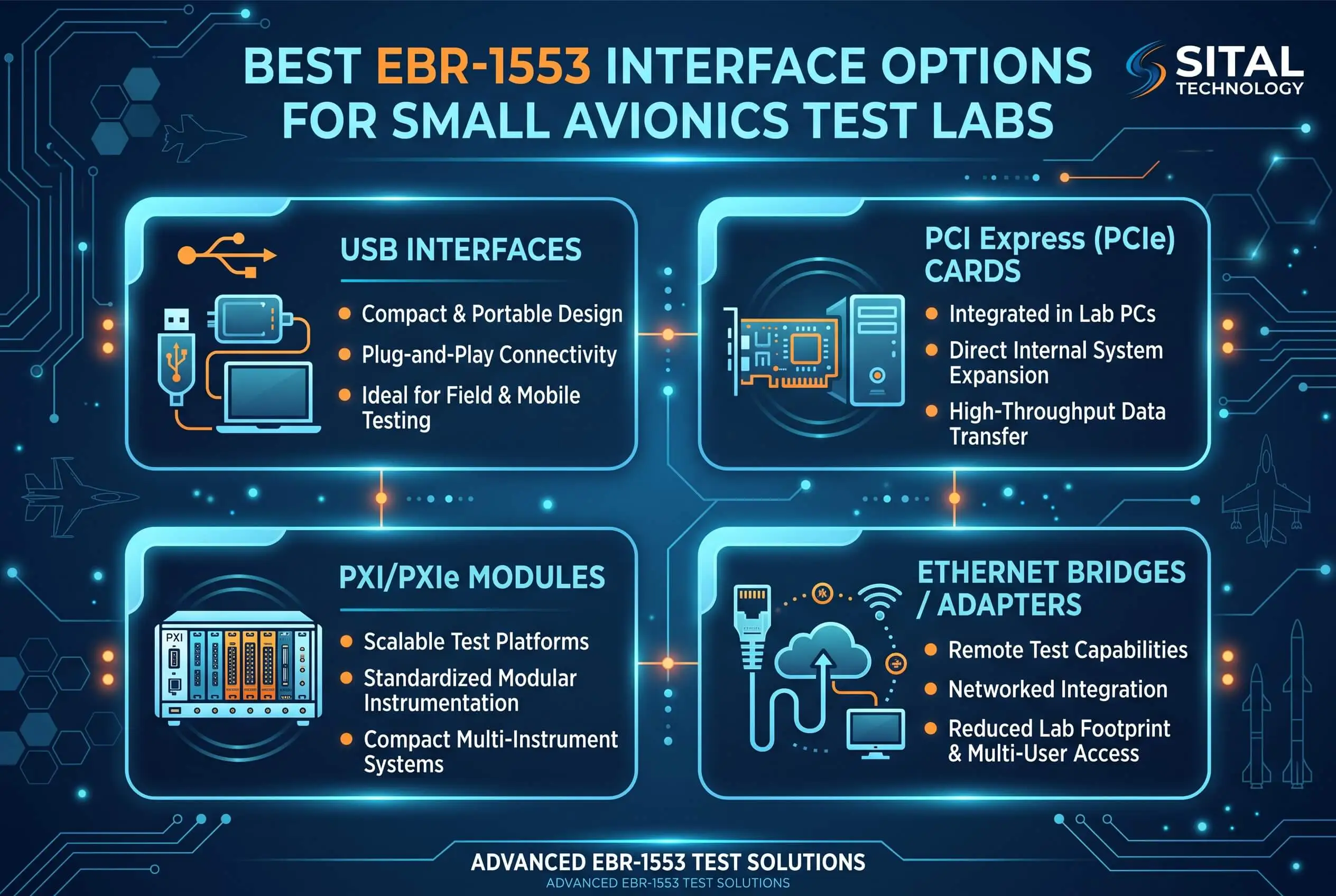
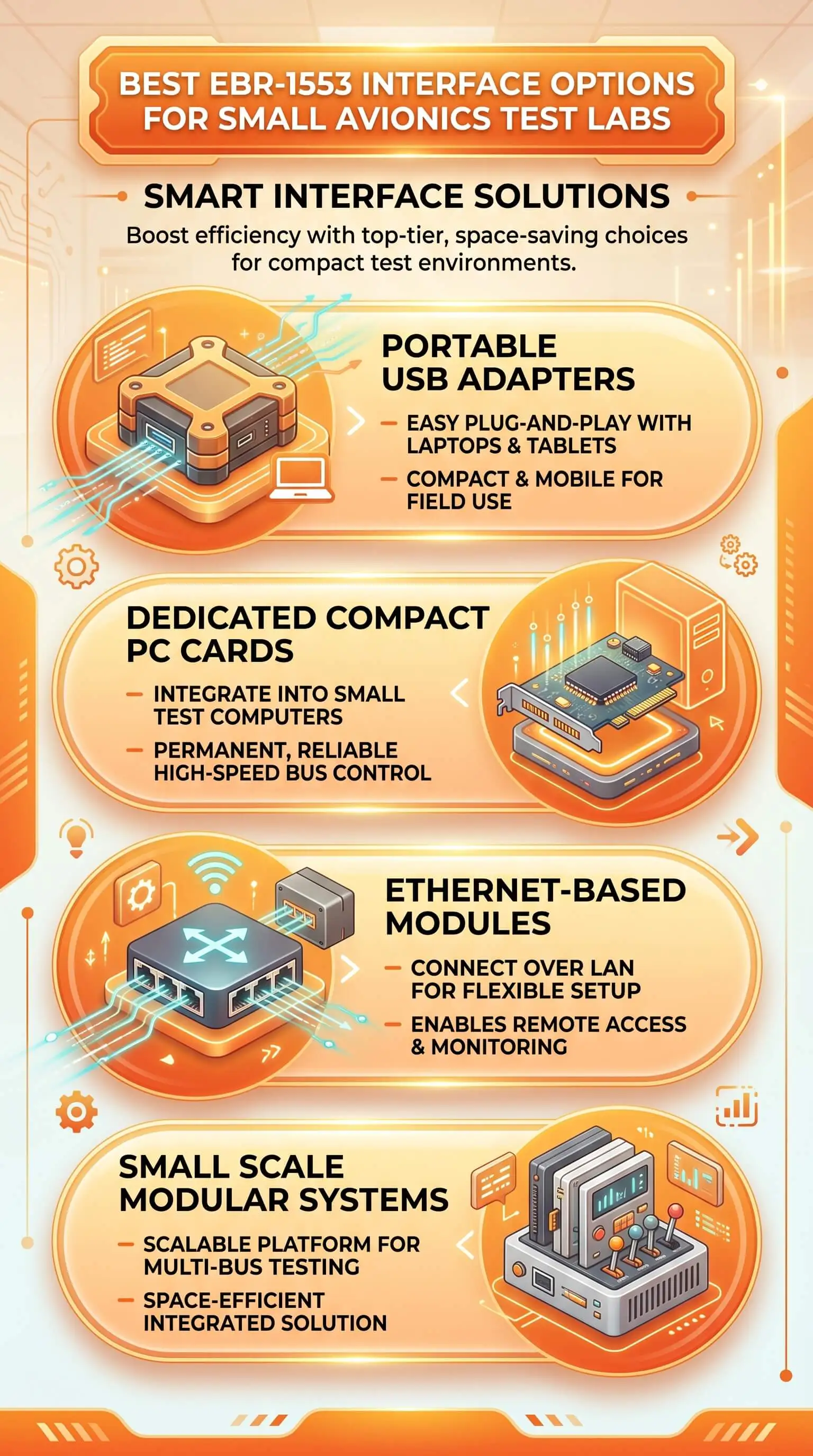
A PCIe, PC/104, or PMC board gets EBR-1553 onto a desktop bench fastest. Pick the form factor by the chassis you already own. Most boards put a bus controller, remote terminal, and monitor on a single card, which is usually everything a small lab needs.
Portable and Ethernet-host units
When slot space is tight or the bench is shared, a small mezzanine or Ethernet-hosted unit keeps the interface off the motherboard. Check channel count and supported modes against your test plan before you order.
The software layer
Small teams underrate the software layer, and it usually decides the schedule. An interface whose API matches your current 1553 toolchain lets you reuse test code instead of rewriting it. That single choice saves more engineering time than any spec on the datasheet.
How to pick without overbuying
Match channel count to the test article in front of you. Most small labs need one or two remote terminals plus a monitor, not a high-density integration card. Confirm one device can run all three roles before you buy three. And if your cable runs are long, look for built-in fault and signal-integrity checking, because RS-485 over distance causes most of the intermittent EBR-1553 trouble we run into.
"The mistake I see most in small labs is the cabling, not the hardware choice. A team buys a solid EBR-1553 card, then tries to drop it onto the 1553 harness already sitting on the bench. We started wiring one remote terminal straight off the hub, proving the link at 10 Mb/s, and only then scaling up. Once the API matched what we already ran for 1553, integration went from a two-week slog to an afternoon."
Essential Resources
Seven references worth bookmarking before you spec an EBR-1553 bench, from the standards background to hands-on wiring notes.
Military Embedded Systems: Enhancing MIL-STD-1553's bit rate. A clear technical walk through EBR-1553 topology and the implementation form factors available.
SAE International: the origin of the AS5652 standard. How MMSI and EBR-1553 became a formal SAE protocol, told by the people who wrote it.
Holt Integrated Circuits: HI-6140 EBR-1553 development kits. A single-chip bus controller, monitor, and remote terminal that ships with source code.
Alta Data Technologies: MEZ-EBR AS5652 mezzanine card. A small Ethernet-hosted board with a reusable, cross-platform API.
Sealevel Systems: EBR-1553 IP core for FPGA and ASIC. The IP core route for labs that design their own hardware.
Data Device Corporation: EBR-1553 PC/104 board. A plug-in board built on the proven Enhanced Mini-ACE core.
Abaco Systems: Application Note 006 on setting up an MMSI (EBR-1553) bus. Practical wiring guidance that heads off the integration mistakes labs hit most.
Supporting Statistics
10 Mb/s. EBR-1553 runs ten times faster than standard MIL-STD-1553, which moves data at 1 Mb/s. Source: Avionics International.
31 remote terminals. A 1553 bus addresses up to 31 remote terminals, the same ceiling EBR-1553 carries over from its parent standard. Source: GRID.
1973. The US Air Force adopted MIL-STD-1553 in 1973, the protocol EBR-1553 builds on, and it's still flying more than 50 years later. Source: European Space Agency.
Final Thoughts
For a small lab, the best EBR-1553 interface is rarely the most capable one. It's the one that covers your channel count, runs all three roles, and speaks an API your team already knows. Buy for the test article in front of you, not the program you hope to win next year. If you build your own hardware, an IP core wins on cost. If you don't, a single multi-role board gets you testing soonest. Plan the cabling with the same care you give the card, because that's where small labs lose the most time.
One opinion worth stating plainly: spend the extra hour up front confirming software compatibility, the same way a garage cleanout goes smoother when the sorting plan is clear before anything gets moved. Datasheets make hardware easy to compare. Rewriting a working 1553 test suite is the cost that quietly wrecks a schedule.
Frequently Asked Questions
What is EBR-1553?
EBR-1553, or Enhanced Bit Rate 1553, is a 10 Mb/s version of MIL-STD-1553. It uses the same command/response protocol but runs over RS-485 in a star (hub) topology.
Will EBR-1553 work with my existing MIL-STD-1553 cabling?
No. EBR-1553 uses an RS-485 physical layer and a star (hub) layout, so it won't run on a legacy 1553 multidrop harness. Plan new cabling when you adopt it.
What's the cheapest way to add EBR-1553 to a small bench?
If your team designs its own boards, an IP core paired with standard RS-485 transceivers costs least over time. If not, one plug-in board that handles all three roles is usually the most economical choice once you count engineering hours.
Can one interface act as a bus controller, remote terminal, and monitor?
Yes. Most EBR-1553 boards and integrated terminals can be set for bus controller, remote terminal, or bus monitor operation, which is why one device often covers a small lab.
How many remote terminals does EBR-1553 support?
Up to 31, the same ceiling as MIL-STD-1553. Most small test setups use far fewer.
Choose the Right Setup for Your Lab
Match the interface to your bench, not to a spec sheet. Compare IP cores, boards, and software side by side on the Sital EBR-1553 page linked above, then shortlist the one that runs all three roles and speaks your existing 1553 API, the same way a digital marketing agency compares tools against real campaign needs instead of generic feature lists. Get that pairing right, and your next EBR-1553 build takes an afternoon instead of a sprint.