The most expensive mistake I see in direct primary care costs nothing to make. A physician builds something better than what the town already has, prices it fairly, explains it beautifully across a desk, then puts up a website that sounds like every insurance clinic on the same street.
So the honest answer to the question above is probably yes. The version somebody sold you isn't it.
I know why the word lands badly. You didn't leave a volume business to start running funnels, and “marketing” sounds like the thing you escaped: dashboards, retainers, an agency that has never met one of your patients. Fair.
What you're deciding is narrower than that. Can the people in your town who would love what you built find out you exist, and once they have, can they work out what a membership actually gets them? Two yeses and you can spend nothing this year. One no and you have a problem good medicine can't reach, because the people who need you never make it as far as your exam room.
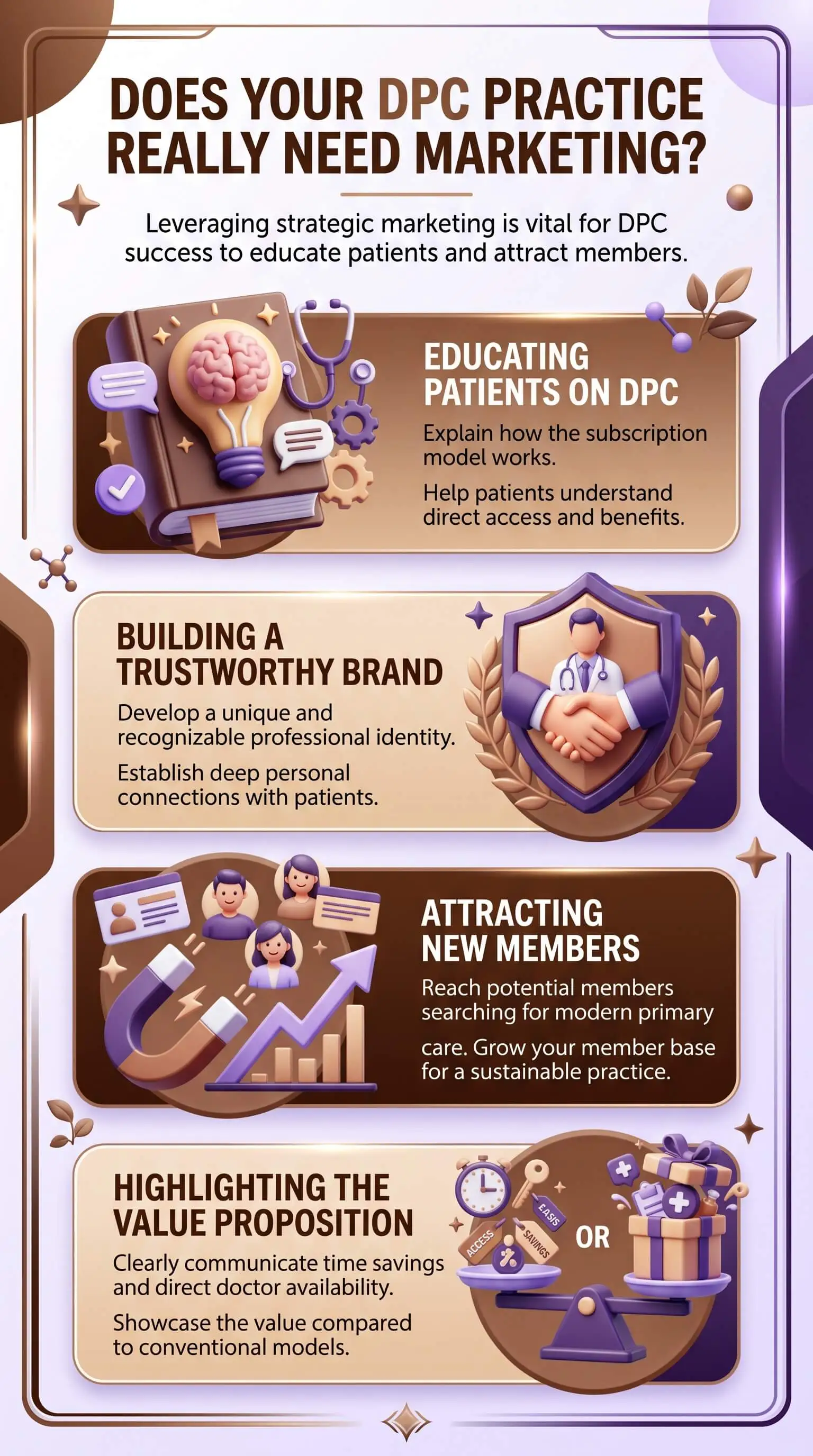
Here's what DPC physician marketing and physician marketing help can do for your practice, including the cases where I'd tell you to keep your money.
TL;DR Quick Answers
physician marketing help, dpc physician marketing
Physician marketing help means support with getting a practice found and chosen: website copy, local search, reviews, and email. DPC physician marketing is that same work aimed at a membership model, where the goal is a full recurring panel instead of one-off visit volume.
The difference matters more than most owners expect. A DPC panel averages about 413 patients, per the AAFP, so retention outweighs reach. Your copy also carries two loads at once, because it has to explain a payment model most people have never encountered and make a monthly fee feel like relief rather than one more bill.
Where the work goes, in order:
Website first. Price, what's included, how to join, all answerable without a phone call.
Local search second. A DPC page, a complete Google Business Profile, free directory listings.
Reviews third. Ask on purpose, by text or email, within a day of the visit.
Email fourth. Retention and renewals for the members you already have.
Ads last, if ever. They stop the day you stop paying. A page that ranks keeps earning.
My honest read: most DPC practices aren't under-marketed. They're under-explained.
Top Takeaways
Marketing isn't optional, but spending might be. If you're near panel capacity with a waitlist, work on retention and spend nothing this quarter.
Fix the website before the ad budget. Traffic sent to a page that can't explain membership leaks, and you pay for every drop.
Your copy carries two loads at once. It has to teach an unfamiliar model and justify a recurring fee in the same breath, which makes this a writing problem rather than a channel problem.
Honest marketing compounds. Ad spend resets to zero the day you stop paying. A page that ranks keeps earning after you've forgotten about it.
Fill a panel, not a waiting room. With roughly 400 members carrying the practice, the physician marketing help that matters most is whatever keeps them renewing.
Some DPC Practices Don't Need Marketing Yet
Let me start where most marketers won't.
If your panel is full or nearly full, and members keep sending you their neighbors, spend nothing on marketing this quarter. Put it toward staff instead, or take the evening back.
The same answer holds if any of this describes you:
You're capping the panel on purpose to protect same-day access, and you're close to the cap.
Referrals from current members already arrive faster than you can absorb them.
A waitlist sits there that you haven't worked through.
You haven't opened and you don't have a website, in which case the website is the job. Filing it under “marketing” makes it sound optional.
Practices in that position need retention, not reach. Keep the members you have, make it easy for them to talk about you, and let the panel fill the slow way. That's a strategy, not the absence of one.
I turn down work over this. Tell me you're at 380 members with a waitlist and I won't sell you a content package.
When DPC Physician Marketing Stops Being Optional
The turn is rarely dramatic. It looks like this:
New-member inquiries have been flat for two months running.
People call to ask whether you take their insurance, which means your page never explained the model.
You search “direct primary care near me” from your own phone, in your own city, and you aren't there.
Every new member traces back to one referral source that could dry up tomorrow.
You hired someone, or signed a lease, against growth that hasn't shown up.
Members join and then quietly lapse around month four.
Any two of those together and the problem stopped being clinical a while ago.
Direct primary care is harder to market than the clinic across town, and the reason is structural. Your words carry two loads at once. They explain a payment model most people have never encountered, and they make a recurring monthly fee feel like relief instead of one more bill. An insurance practice mostly has to say we're here, we're open, we take your plan. You teach and sell in a single breath, to someone already wary of anything in healthcare that asks for money up front.
That's a writing problem before it's a channel problem. Which is why practices that buy ads first so often feel like they burned the money. They did. They paid to send strangers to a page that couldn't answer the only three questions those strangers arrived with. The American Academy of Family Physicians keeps a clear primer on the model if you want it laid out plainly.
What Physician Marketing Help Actually Looks Like for a DPC Practice
Sequence matters more than any single tactic, so take them in this order.
Start with the website. Membership price, what's included, what isn't, how to join. A person deciding whether to trust you with their family's health should not have to work at understanding you.
Add local search next. One strong DPC page and a complete Google Business Profile. Someone typing “direct primary care near me” is already reaching for a card. List yourself on the DPC Frontier Mapper while you're at it, which costs nothing and takes a day or two to appear.
Ask for reviews on purpose. By text or email, within a day of the visit. Happy patients rarely think to do it on their own. The unhappy ones always do.
Use email to keep the members you earned. Retention is the business in a membership model. One member who renews for four years beats four who leave at month five.
Leave ads for last, if ever. They cover a gap or launch a second location. They also stop the day you stop paying, while a page that ranks keeps earning.
What I do is the words: web copy, SEO content, email. Ad management and off-page SEO sit outside my lane, so I bring in partners, including a trusted digital marketing agency, when a plan genuinely calls for them. Anyone claiming to do all of it equally well is selling you something.
The 2026 Change Most DPC Websites Haven't Caught Up To
One last thing, and it's new.
For years a DPC membership disqualified a patient from contributing to a health savings account. That ended. Under the tax law enacted in July 2025 and the IRS guidance that followed, qualifying direct primary care arrangements no longer block HSA contributions for months beginning after December 31, 2025, and membership fees can count as qualified medical expenses paid from an HSA. The eligibility rule caps fees at $150 a month for one person, or $300 where the arrangement covers more than one.
Most DPC memberships run $50 to $100 a month, which clears that cap easily. Almost no DPC website mentions any of it.
You can answer a real money objection now, and it's sitting there unused. Confirm your own arrangement qualifies with your accountant, then put it somewhere a prospective member will actually read it.

“The thing I get hired for usually isn't the thing that's actually wrong. Someone arrives certain they have a traffic problem. They want blog posts, they want to be everywhere, they want the number to go up. Then I read their site and the traffic is fine. People are finding them. Those visitors just can't work out what a membership costs, what it covers, or what happens the first time they need a specialist, so they drift back to the clinic they already know how to use. Sending more people to that page fixes nothing. It means paying to lose in higher volume. I came into healthcare sideways. I write for tabletop creators running crowdfunding campaigns, where you get one window, no do-overs, and one badly worded page can sink a year of work. That teaches you to treat every sentence as load-bearing. Direct primary care asks the same thing, because you're asking someone to leave a system they understand, however much they complain about it, and pay you monthly instead. That decision turns on clarity and not much else. Which is why I usually give people the unglamorous version. You probably don't need an agency or a five-figure ad budget. You need a website that answers the obvious questions, a few pages that rank for what your future members are typing, and the habit of emailing the people who already said yes. I'd rather say that and lose the bigger invoice.”
7 Essential Resources
Seven things worth reading before you spend anything. Every link checked the week this went live.
Understand the model you're selling. A plain overview of direct primary care, with average panel size, fee ranges, and how DPC differs from concierge care. Source: American Academy of Family Physicians
See who you're competing with. A live national map of DPC practices, filterable by pure, hybrid, and onsite. Look up your ZIP code, then add your practice free if it isn't listed. Source: DPC Frontier Mapper
Get the 2026 HSA rules right. Official guidance on how qualifying DPC arrangements work with health savings accounts, including the fee limits and what counts as primary care. Source: Internal Revenue Service, Notice 2026-5
Market without breaking HIPAA. When you may use patient information in marketing, and when you need written authorization first. Read it before publishing a single testimonial. Source: U.S. Department of Health and Human Services
Keep your claims defensible. What “truthful and substantiated” means in advertising law, so your copy never writes a check your evidence can't cash. Source: Federal Trade Commission
Know the ethical lines for physician advertising. The AMA's opinion on advertising and publicity, which protects your patients and your license at once. Source: AMA Code of Medical Ethics
Write a plan instead of guessing. A walkthrough of audience, positioning, and budget, so your marketing money has somewhere specific to go. Source: U.S. Small Business Administration
These seven trusted resources can help you make smarter marketing decisions, and a freelance healthcare content writer can turn those insights into clear, compliant copy that connects with the right patients.
3 Statistics Worth Knowing First
Three numbers that should change how you weigh the question. All traceable, none from a vendor selling you something.
Concierge and direct primary care practices grew 83.1% in five years. Practice sites rose from 1,658 in 2018 to 3,036 in 2023, and the clinicians staffing them rose 78.4%, per research published in Health Affairs. Being the only DPC in town has a short shelf life. Being easy to find is how you hold the lead after it goes. Source: Johns Hopkins Carey Business School
The average DPC panel runs about 413 patients. That's the whole business: a few hundred people, most paying $50 to $100 a month. Losing six members at that scale hurts more than missing six thousand pageviews, which is exactly why retention beats reach here. Source: American Academy of Family Physicians
61% of patients would skip a physician with poor online reviews even when a friend recommended them. In a survey of more than 1,000 U.S. adults, 84% said they check reviews before booking and 57% said they rarely or never leave one, though nearly three-quarters would if asked. Word of mouth is still your strongest channel. What people find online decides whether it survives the handoff. Source: Medical Economics
These three statistics show why strategy matters more than guesswork, and the same principle applies to TTRPG marketing: sustainable growth comes from being easy to find, building trust, and retaining your audience over time.
Final Thoughts and Opinion
Get findable. Explain membership so clearly that nobody has to call to understand it, keep the members you already earned, and hold the campaign until your website has proven it can close.
Here's my opinion, and I'll say it knowing what it costs me.
Most direct primary care practices aren't under-marketed. They're under-explained. The physician describes the model beautifully across a desk, then the website reads like a brochure for a clinic that takes insurance. Fixing that costs a fraction of an agency retainer. It also works better.
So no, you probably don't need the marketing somebody pitched you. What you need is a handful of pages that tell the truth clearly, in your own voice, where the right people are already looking, plus the patience to let them compound while your competitors rent attention by the click.
Shorter and cheaper than anyone told you.
Frequently Asked Questions
Does a direct primary care practice really need marketing?
It needs to be findable and understandable. Whether that costs money depends on where you stand. A practice near panel capacity with a waitlist should work on retention instead. A practice with flat inquiries, no local search presence, or a website that can't explain membership needs work now, starting with the website.
What is DPC physician marketing?
DPC physician marketing is how a direct primary care practice gets found and chosen. It covers the website, local search, patient emails, and the reviews that explain how membership works and turn visitors into long-term members. Because a DPC practice needs members who stay rather than one-off visits, the target is a full recurring panel instead of a traffic spike.
How do direct primary care practices get new patients?
Usually in this order: a website that converts, local search that catches “near me” queries and directory listings, then reviews and email that keep members and earn referrals. Word of mouth still does the heaviest lifting, though a referred patient almost always checks the website before calling.
Should a DPC practice run ads or focus on SEO?
For most single-location DPC practices, organic search and clear web copy win over time, because a membership model rewards visibility that keeps building. Ads cover a gap or launch a second location, then stop the day the budget does. Get the website and local search right first.
How much does physician marketing help cost?
Scope decides it, and any honest answer starts there. A single page rewrite and a full website rebuild sit at different orders of magnitude. Sequencing matters more than the number anyway: paying for a page that converts before paying for traffic always costs less than the reverse.
Is hiring a copywriter HIPAA-compliant?
It can be done properly. No patient name, photo, or identifying detail should go public without written authorization, and testimonials follow the same rule. If a writer treats compliance as an afterthought, you've learned how they'll treat everything else.
Can patients pay for a DPC membership with an HSA?
As of months beginning after December 31, 2025, qualifying direct primary care arrangements no longer disqualify someone from contributing to a health savings account, and membership fees can count as qualified medical expenses paid from one. Monthly fees cap at $150 for an individual and $300 where the arrangement covers more than one person. Confirm your specific arrangement with your accountant, then say so on your website.
Open Your Own DPC Page and Read It Like a Stranger
Do this before you spend anything. Pull up your membership page on your phone, the way a worried parent would at eleven at night, and time how long it takes to find three things: what it costs, what's included, and what to do next.
If any of them takes longer than a few seconds, you've found your first project, and it isn't an ad campaign.
If you'd rather not do that part alone, here's how my medical healthcare copywriting services help direct primary care and independent practices with the words. And if it turns out you need something I don't do, I'll tell you who to call.