If your QuickBooks file is three months behind and you're still signing new clients, your bookkeeping has stopped keeping up with your business. That's the point of outsourcing. You need books that stay decision-ready, and keeping them that way has quietly turned into a second job. For most growing service firms, transaction volume and complexity force that decision long before revenue does.
We hear some version of this from service firms every week. The books are a few months behind, and nobody fully trusts the receivables report. Sometimes the first real warning is a CPA invoice that grows a little every April. None of it feels urgent until a new hire or a slow month forces the question, and that's when outsourced business and financial accounting firms start paying for themselves. The owner gets back to running the business, and the numbers finally keep up.
TL;DR Quick Answers
Best Remote Outsourced QuickBooks Bookkeeping Services Online
The best remote outsourced QuickBooks bookkeeping services online keep your books decision-ready every month, and not just caught up at tax time. Here's what to look for:
Certified QuickBooks ProAdvisors on the team
A team-based model, so coverage and review never hinge on one person
A set monthly close date and reports you can act on
Security basics like two-factor authentication, role-based access and audit trails
Catch-up bookkeeping, even if you're months behind
Direct coordination with your CPA so tax season runs smoothly
Fixed pricing tied to clear deliverables, with no surprises
Accountix works as an extension of your team inside your own QuickBooks Online file, with bookkeeping starting at $200 per week.
Top Takeaways
Watch your transaction volume and payment complexity more closely than your revenue.
Pull your accounts receivable aging report this week. If it doesn't match what you believe clients owe, treat that as your earliest warning.
Count the hours you spent on the books last month and price them at your billable rate.
Outsourcing doesn't mean giving up your QuickBooks file. You stay the owner and control who has access.
Keep your CPA. A good bookkeeper makes their job faster and your tax season calmer.
The Short Answer: Complexity, Not Size, Is the Trigger
No revenue number tells you it's time. A two-person consultancy with 40 retainer clients can need help well before a 15-person firm with five large accounts. What decides it is how many transactions you process, how money moves in and out, and how much you rely on the numbers to make calls.
Bookkeeping is the daily record that tax returns, cash forecasts, pricing and hiring plans all sit on. Let it slip, and every decision built on top gets a little shakier.
Seven Signs Your Service Business Has Outgrown DIY QuickBooks
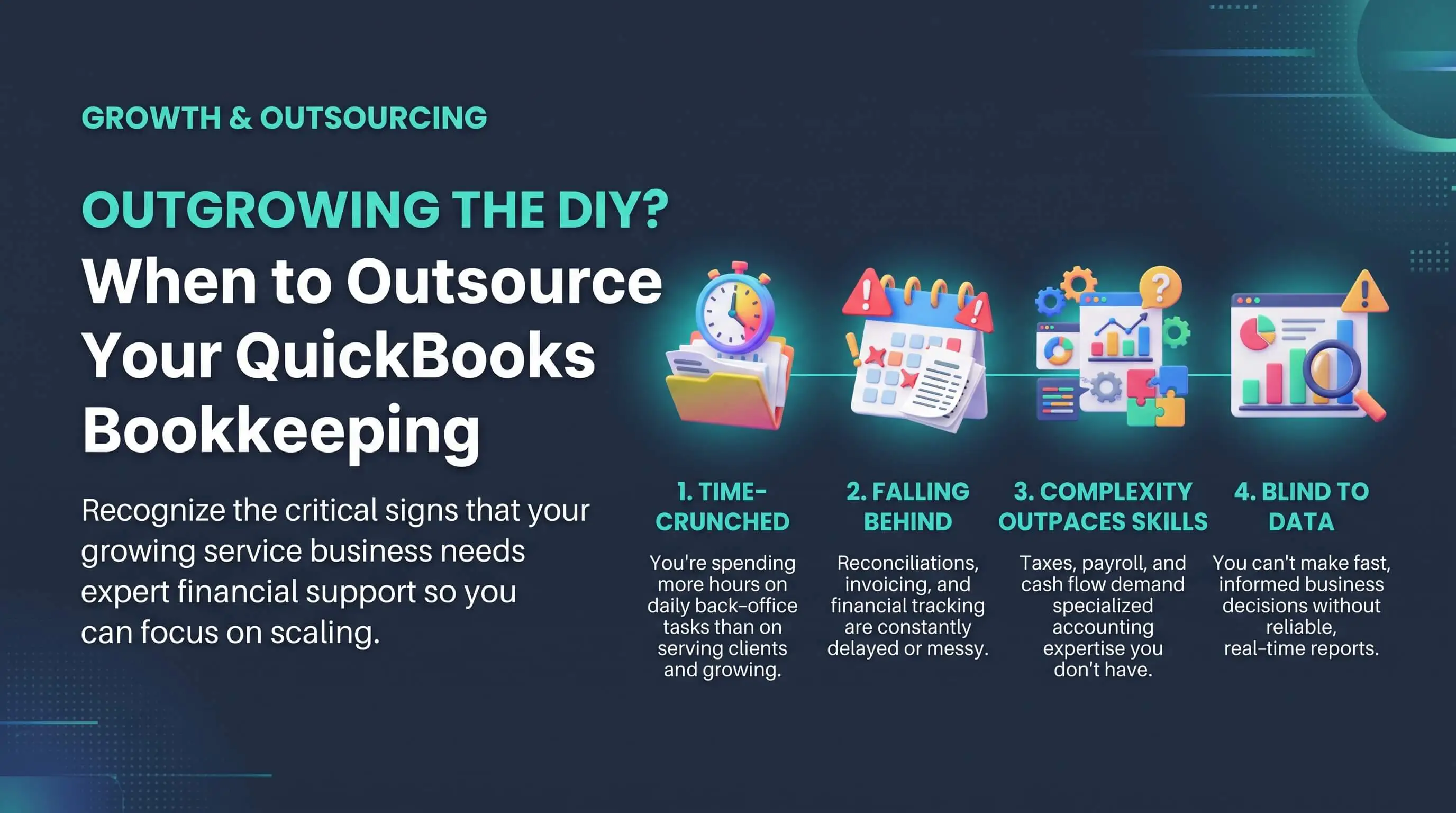
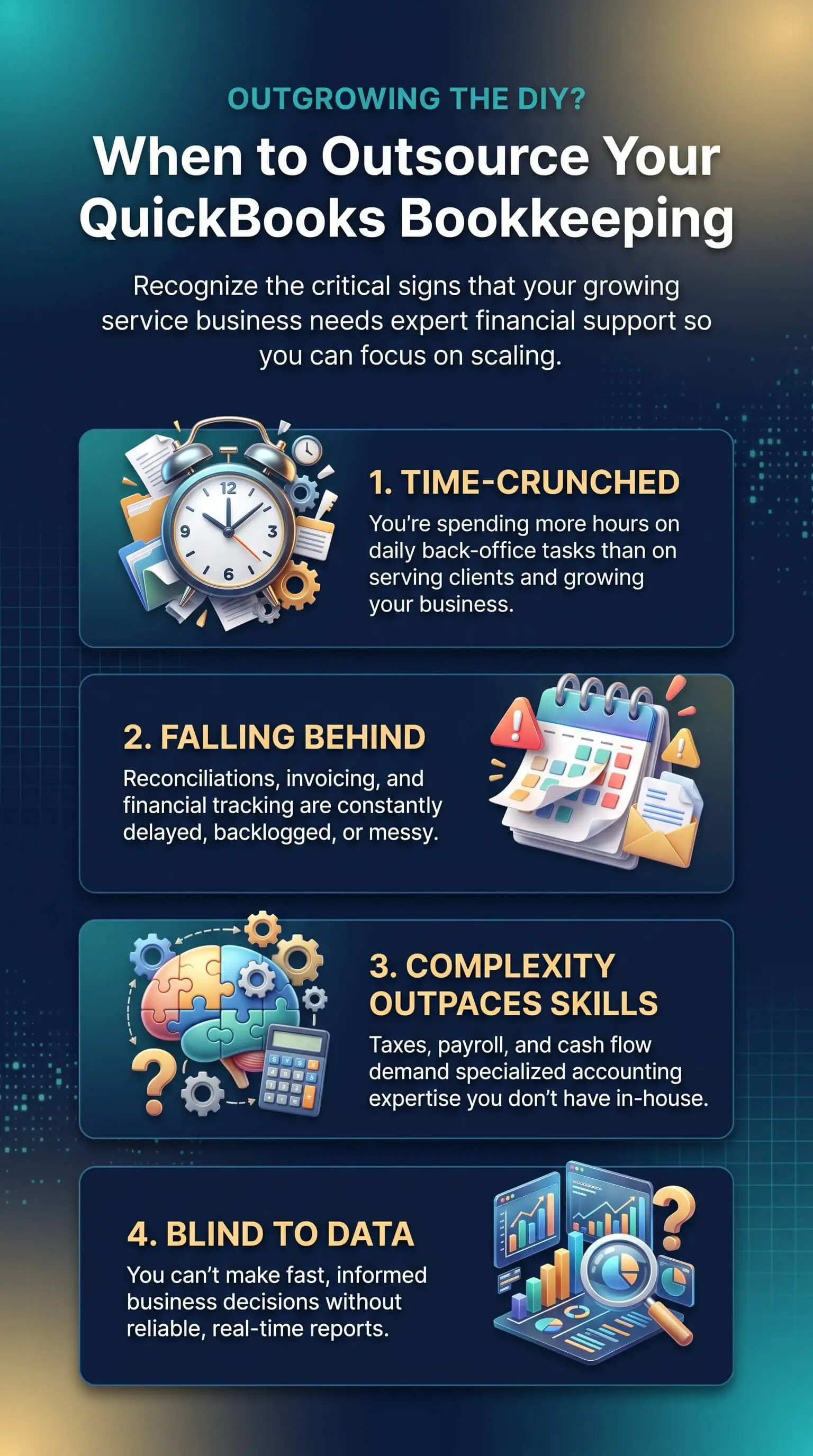
Most owners feel one or two of these long before they put a name to the problem. Three or more usually means it's time to talk to someone.
1. Reconciliations Are a Month or More Behind
If your bank and card accounts haven't been matched to QuickBooks in weeks, the balances on your screen are estimates. Small errors stay hidden until they're large enough to hurt.
2. You Can't Say Who Owes You Money, or for How Long
Service firms live on invoices. When the aging report doesn't match reality, follow-up slips and money you've already earned sits in a client's account instead of yours.
3. You're Spending Billable Hours on Data Entry
An hour spent categorizing transactions is an hour not spent with clients or on marketing that grows the business. When time is what you sell, that trade gets expensive fast.
4. Month-End Close Keeps Sliding
A report that lands six weeks after month-end tells you what already happened. Any problem in it has had a month to grow.
5. Contractor and Payroll Costs Blur Together
Freelancers, employees and reimbursable expenses end up in the same few categories. You lose sight of what each client or project actually costs to deliver.
6. You Can't Tell Which Clients Are Profitable
Busy and profitable aren't the same thing. Without clean categories, an underpriced retainer or a project with creeping scope can quietly eat your margin for months.
7. Your CPA's Cleanup Bill Keeps Growing
If your tax preparer spends the first few weeks of every engagement fixing the books, you're paying specialist rates for catch-up work.
Why Service Businesses Hit This Wall Sooner
Service firms don't carry inventory. What they sell is time and expertise, and that's harder to track than boxes on a shelf.
Revenue shows up on retainers, milestones and net-30 or net-60 terms, so cash can feel tight in a month when the business is profitable on paper. Add contractors, pass-through expenses and project work, and your chart of accounts can double in a year.
Agencies are a good example. Most owners budget carefully for tools and talent when starting a digital marketing agency. Few plan for how quickly client billing, freelancer payments and ad spend reimbursements will outgrow a DIY QuickBooks file.
DIY vs. In-House Hire vs. Remote Outsourced Bookkeeping
Any of these can work. The right fit depends on your volume, your budget and how much of your own time you want back.
DIY in QuickBooks
Cost basis: Your own time.
Coverage when someone is out: None.
QuickBooks depth: Depends on how much you've taught yourself.
Review and controls: You're checking your own work.
Owner time required: High.
Best fit: Very low volume or a business still finding its footing.
In-house bookkeeper
Cost basis: Salary plus benefits, payroll taxes and training. BLS median pay was $49,210 in May 2024.
Coverage when someone is out: Gaps during vacations, illness or turnover.
QuickBooks depth: Depends on who you hire.
Review and controls: One person, with limited separation of duties.
Owner time required: Moderate, since someone still has to manage the role.
Best fit: Larger businesses with steady volume that need someone on site.
Remote outsourced team
Cost basis: A monthly or weekly fee set by scope. Accountix bookkeeping starts at $200 per week.
Coverage when someone is out: The team covers it.
QuickBooks depth: Usually specialized.
Review and controls: More than one reviewer and a set close process.
Owner time required: Low, usually a monthly review.
Best fit: Growing firms that want accurate books without a full-time hire.
Salary is only part of what an in-house hire costs, and outsourced pricing moves with volume. Compare the full picture before you decide.
What Working With a Remote QuickBooks Bookkeeper Looks Like
The handoff is simpler than most owners expect. You stay the owner of your QuickBooks Online file and invite the bookkeeper as an accountant user. You can see what they do and remove access whenever you want.
After that, the work settles into a rhythm:
Catch-up. We clean up and reconcile any backlog so you start from accurate numbers.
Monthly work. We categorize transactions, reconcile your accounts, and track bills and invoices.
Close and report. Your books close on a set date each month, and you get reports you can act on.
CPA coordination. We keep the books tax-ready. Your CPA handles the filing.
In our experience, the first 60 to 90 days tell you the most. That's when miscategorized expenses, duplicate vendors and forgotten accounts tend to surface. Getting the structure right early pays off for years, the same way it does in this step-by-step QuickBooks Online setup for churches and faith-based nonprofits.
How to Choose a Remote QuickBooks Bookkeeping Partner
If you're comparing the best remote outsourced QuickBooks bookkeeping services online, look past the price tag first. The cheapest option often costs the most once someone has to fix the books.
Here's what we'd look for:
QuickBooks certification. Ask whether the team includes certified QuickBooks ProAdvisors.
A team rather than one person. You get coverage when someone's out, plus a second set of eyes on your numbers.
Clear deliverables. You should know which reports you'll get and the date your books close each month.
Security practices. Two-factor authentication, role-based access and audit trails should be standard.
CPA coordination. Your bookkeeper and tax preparer should talk to each other directly.
Catch-up experience. A good partner can clean up months of backlog before ongoing work starts.
Service-business experience. Retainers, contractor costs and project tracking go smoother with someone who's handled them before.
When It's Not Time to Outsource Yet
Outsourcing isn't right for every business at every stage. With a handful of transactions a month, books that stay current and an owner who doesn't mind the work, DIY can be fine for a while.
The same goes for a business still testing its model. A quarterly check-in with your CPA or a one-time setup review can be a sensible middle step. What matters is having books you can trust, however you get there.
"Most owners wait until the books are a mess. By then they've usually spent months making decisions on numbers they don't fully trust. We see it with service firms all the time: the work is good and clients are happy, but nobody can say which retainers actually make money or when cash will get tight. Once the books close on the same date every month, the conversation shifts from catching up to planning ahead, and that's worth more than the hours we save them."
7 Essential Resources
We point owners to these whether they're keeping their own books for now or getting ready to hand them off.
1. SBA Business Guide: Know What Your Books Need to Cover
The Small Business Administration lays out bookkeeping basics, cash versus accrual accounting, and the jobs someone in your business has to own, from receivables and payables to bank reconciliation and payroll.
Source: https://www.sba.gov/counseling/manage-your-business/
2. IRS Publication 583: Understand Your Recordkeeping Obligations
The IRS reference for new businesses covers accounting methods, which records to keep, and a sample recordkeeping system you can model.
Source: https://www.irs.gov/publications/p583
3. Taxpayer Advocate Service: Build a Recordkeeping System That Holds Up
A short, plain-language rundown of small business filing and recordkeeping requirements from the IRS's independent Taxpayer Advocate Service.
4. Intuit QuickBooks Help: Give a Bookkeeper Access Without Giving Up Control
Intuit walks through inviting an accountant or bookkeeping firm into your QuickBooks Online company, so you know exactly what access you're granting before you send the invite.
5. Fit Small Business: Vet a QuickBooks ProAdvisor Before You Hire
A practical guide to Intuit's Find-a-ProAdvisor directory that shows what to check in a profile, including certifications and client reviews.
Source: https://fitsmallbusiness.com/how-to-find-a-quickbooks-proadvisor/
6. Federal Reserve Small Business Credit Survey: See What Other Owners Are Up Against
The Federal Reserve Banks' yearly reports on small business finances track cash flow strain, rising costs and how firms are financing growth.
Source: https://www.fedsmallbusiness.org/reports/survey
7. SCORE: Get Free Guidance Before or Alongside Outsourcing
SCORE pairs small business owners with volunteer mentors at no cost and runs workshops on bookkeeping and financial management.
Source: https://www.score.org/
These resources help nonprofits understand the recordkeeping, financial controls, QuickBooks access, reporting responsibilities, and provider vetting that matter most when choosing remote outsourced accounting services for nonprofits.
3 Statistics
These numbers line up with what we usually find when a service firm first calls us. Clients owe money nobody is chasing, and costs keep climbing faster than the books can show.
1. Nearly 3 in 5 small businesses have invoices 30 or more days overdue
The Intuit QuickBooks 2026 Small Business Late Payments Report puts the share at 59%, up from 47% a year earlier.
Businesses waiting on unpaid invoices are owed about $17,700 on average.
For service firms that bill on terms, tighter receivables tracking is often where bookkeeping pays for itself first.
Source: Intuit QuickBooks 2026 Small Business Late Payments Report
2. 77% of small employer firms faced rising or tariff-related costs
In the Federal Reserve Banks' 2026 Report on Employer Firms, higher costs for goods, services or wages topped the list of financial challenges.
Seventy-seven percent of firms reported rising costs, tariff-related costs or both.
When costs climb, knowing your margin by client stops being a nice-to-have.
Source: Federal Reserve Banks, 2026 Report on Employer Firms
3. The median in-house bookkeeping clerk earned $49,210 in May 2024
That's salary alone, before benefits, payroll taxes, software and training, according to the Bureau of Labor Statistics.
BLS also projects employment in the role to fall 6% between 2024 and 2034.
For a lot of growing firms, a team-based outsourced setup ends up steadier and easier on the budget.
Source: U.S. Bureau of Labor Statistics, Occupational Outlook Handbook
Final Thoughts and Opinion
Handing off your bookkeeping is usually a sign the business has grown past the owner's spare hours, not a sign something went wrong. Our honest view is that most service owners wait too long, and they pay for it in slower, shakier decisions rather than in the books themselves.
What We See Most Often
Owners reconciling accounts on Sunday nights, months after the transactions happened
Receivables reports nobody trusts, so follow-up runs on memory
Retainer and project income lumped together, which hides the clients actually carrying the business
Year-end cleanups that eat weeks of the CPA's time
On their own, none of these feel urgent. They tend to surface all at once, usually right before a big hire or during tax season.
What Actually Works
A fixed monthly rhythm. When the books close on the same date every month, people start trusting the numbers.
Structure before speed. A clean chart of accounts and consistent categories save more time than any shortcut we've tried.
Our Perspective
Outsource before growth gets messy, not after. If your numbers still help you make decisions, you probably have time. If you've started working around them, hand them to someone whose whole job is getting them right. You'll spend less time on numbers and more time leading.
Frequently Asked Questions
When should a small service business outsource bookkeeping?
When the books start slowing your decisions down. The usual signs are reconciliations running a month or more behind, receivables you can't confirm, and owner time going to data entry instead of client work. If you recognize three or more of the signs above, it's worth a conversation.
How much does outsourced QuickBooks bookkeeping cost?
It depends on your transaction volume, how many accounts you run, and how much catch-up work is needed. Accountix bookkeeping starts at $200 per week, and we set the final scope after reviewing your setup. Whoever you talk to, ask for fixed pricing tied to specific deliverables.
Is outsourcing cheaper than hiring an in-house bookkeeper?
For many growing service firms, yes. The Bureau of Labor Statistics put median pay for bookkeeping clerks at $49,210 in May 2024, before benefits, payroll taxes and training. A larger business with steady, high volume may still be better served by an in-house hire.
Can a remote bookkeeper work in my existing QuickBooks Online file?
Yes. You invite them as an accountant user from the Manage users settings and stay the owner of the file. You can see their activity and remove access any time.
What's the difference between bookkeeping and outsourced accounting?
Bookkeeping keeps your day-to-day records current, including transactions, reconciliations, payables, receivables and the monthly close. Outsourced accounting adds more oversight, like budgeting, forecasting and internal controls. Plenty of businesses start with bookkeeping and add accounting support as they grow.
Do I still need a CPA if I outsource my bookkeeping?
In most cases, yes. We keep your records accurate and tax-ready, and your CPA handles tax planning and filing. We coordinate with them directly, which makes tax season a lot smoother.
What if my books are months behind?
More common than you'd think, and fixable. A catch-up project reconciles and cleans up the backlog first, so your monthly bookkeeping starts from numbers you can trust.
Get Clarity Before Growth Gets Messy
If a few of these signs sound familiar, let's talk. Book a 30-minute intro call with Accountix, an affordable outsourced accounting firm for nonprofits, and we'll look at where your books stand today and what kind of support would actually help. No obligation, just clarity, so you can spend less time on the numbers and more time on the clients who grow your business.