Your slow Tuesday isn’t a demand problem.
Sales through shops like yours have climbed seventeen years running. The category is fine. So when two tables sit empty at 6:40 and a family of four drifts back out of your board game aisle without buying anything, whatever broke is local… and it’s almost never your prices.
That family didn’t cost you a sale. They cost you a regular, which runs a great deal more expensive.
Most advice about this jumps straight to channels: post more, run ads, start a newsletter, pick a platform. That work matters eventually. The moves that actually fix a Tuesday happen within a few miles of your door and inside your own four walls. That’s where effective game store marketing begins. Seven of them below, roughly in the order I’d take them on. None need a bigger ad budget.
TL;DR Quick Answers
Game Store Marketing
Game store marketing is how a hobby shop, FLGS, or game café gets local players through the door and keeps them coming back. Online sellers will always undercut you on price, so the return sits in what they can't ship: a room, an open table, and staff who know what to put in your hands. Highest-return moves, roughly in order:
Get findable. Fill out your Google Business Profile properly, then keep asking regulars for reviews. Nearly half of shoppers skip a business showing fewer than 20.
Run events people can plan around. Beginner nights, tournaments, learn-to-plays. That's what makes somebody drive past a big-box store to reach you.
Start an email list at the register. Wire it to the event calendar. One short note fills a table on a dead Tuesday.
Commit to one social platform. Whichever your regulars already use.
Train the floor. One question ("who's playing, and how long have you got?") plus two recommendations beats twelve options on a shelf.
Bottom line: you win on the room, the staff, and the regulars. Price is a fight you'll lose.
Top Takeaways
Your neighbors are the cheapest channel you own. Trade promotion with the café, the brewery, the library, and the school before you spend a dollar on ads.
A staffed demo table outperforms any display. It gives browsers permission to stop and gives staff a reason to talk.
Pay for frequency, not spend. Regulars are the business. Points-per-dollar rewards people who were buying anyway.
The 48 hours after an event decide whether a first-timer returns. Get names at the table, and name the next date before they leave.
Reviews expire. Nearly half of shoppers skip businesses under 20 reviews, and three-quarters read only the last three months.
What Local Marketing Actually Means For A Game Store
Marketing isn’t complicated, and it isn’t advertising in a better suit. Strip the textbook disciplines down to what applies to a business with a street address, and one fact rearranges all the math. Your audience is finite, and it already lives close by.
You aren’t chasing everyone. You’re after the few thousand households inside a fifteen-minute drive who’d love your shop if they knew it was there. That’s a small enough number to go and get, one relationship at a time. It also means three fairly different people come through your door:
Hobbyists. Cards, minis, TTRPGs. They want singles, restocks, and standing in the tournament. They’ll also clock a marketing voice that doesn’t know the hobby from across the room, which is why authenticity carries so much weight with this crowd.
Café players. They want an open table, something to drink, and two hours with friends.
Families. Usually the parents. They want something to do that isn’t a screen, and they need somebody to narrow the shelf down for them.
Most shops aim everything at one of those three, then wonder where the other two went.
One belief sits under all of it. You win on the room, the staff, and the regulars who keep turning up. Price is the single field where you’re outgunned, so quit playing on it.
Seven Local Strategies That Fill Tables
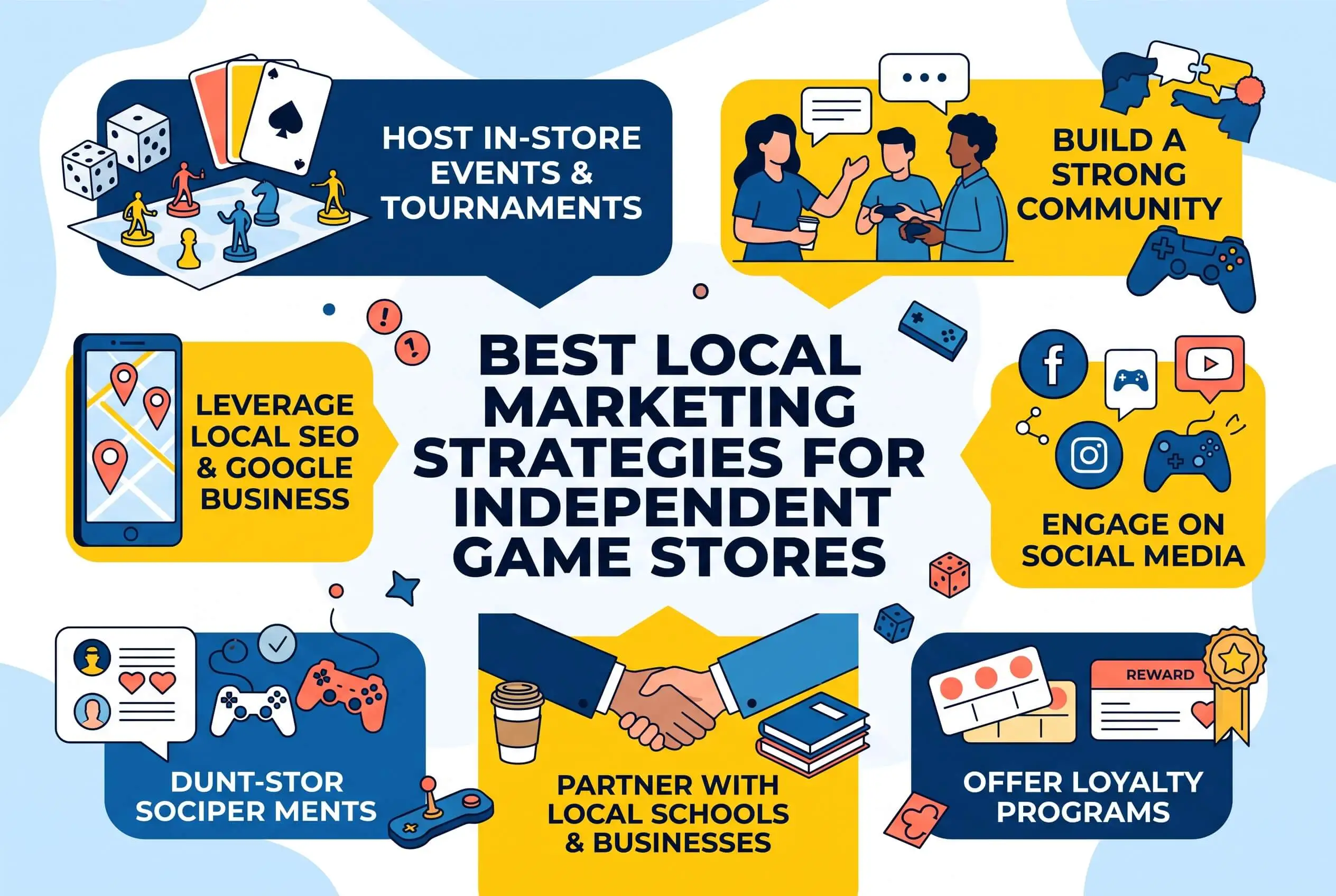
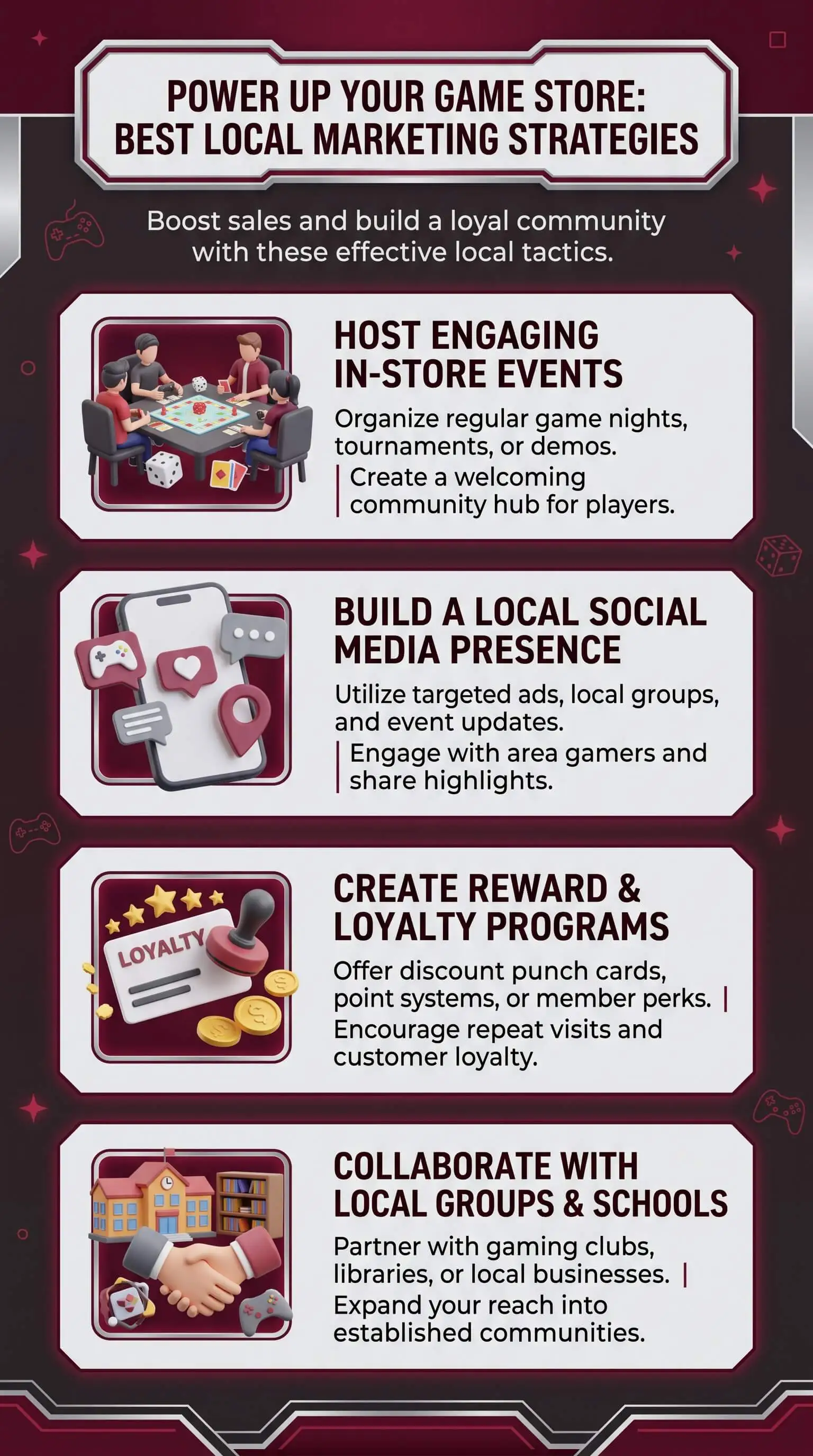
1. Trade Promotion With The Businesses Around You
Your neighbors are sitting on your customers. The coffee shop holds parents killing an hour before pickup. The brewery holds adults hunting for something to do on a Thursday. Libraries, middle schools, comic shops, after-school programs… every one of them serves your people, and not one competes with you.
Make the trade concrete. Your demo copies on their counter, their flyers by your register, one co-hosted night a quarter. Start with two partners. Ten will collapse by March.
2. Set Up A Demo Table And Staff It
An open, half-played table is the best-performing square footage in the building. It gives a browser permission to stop walking, and it hands your staff an opening that isn’t “can I help you find something.”
Pick a game that teaches in under five minutes. Reset it every morning. Swap it weekly. If you’re stuck on what to put out, the same instincts that tell you whether a game will land with an audience work here too.
3. Train The One-Question Recommendation
No online retailer can copy this, and most shops leave it to luck. Teach everyone on the floor one diagnostic question: who’s playing, and how long have you got? Then hand over two options instead of twelve.
Those thirty seconds are the part customers repeat to their friends afterward. It’s word of mouth, and you’re already paying for it.
4. Reward Frequency, Not Spend
Points-per-dollar schemes pay out to the customer who was buying anyway. A shop that runs on regulars should pay for showing up instead.
An event punch card costs almost nothing, and nothing at all when it goes unredeemed. Paid membership tiers (a monthly fee covering table reservations, storage, early access) work nicely once you’ve built a real core, and land with a thud before you have. Whatever you pick has to survive being explained at the register in one sentence.
5. Get On Every Local Calendar
Unglamorous, mostly free, badly underused. Your city events page, the library newsletter, the neighborhood Facebook group, the campus listserv, the parenting group, the paper’s weekend roundup.
Submit the recurring events once, then send the odd ones as they come up. Ten minutes a week here beats most small ad budgets, because you turn up while people are still working out what to do on Saturday.
6. Own The 48 Hours After An Event
Most shops treat a learn-to-play night as the finish line. Whether a first-timer comes back gets decided over the following two days instead. Did anybody get their name? Did they hear when the next one runs? Did they leave feeling expected?
Collect names at the table rather than the door. Then say the next date out loud before they walk out.
7. Merchandise For The Shopper Who Can’t Decide
Back to that family in aisle two. They aren’t short of options, they’re drowning in them.
Staff-pick shelf talkers, a clearly signed family shelf, “if you liked X, try Y” cards, and a visible price on everything will convert more browsers than any campaign you could buy. Total cost: a weekend of sign-making. Keep the wording consistent with everything else you put out, and a one-page brand voice guide covers that.
Where The Digital Side Picks Up
All seven of those assume people can already find you. That half of the job runs on different machinery: your Google Business Profile, an email list wired to the event calendar, one social platform you actually stay with. It’s a discipline on its own, and cramming it into a section here would do it no favors.
If that’s the half you’re shakier on, Riley James Copy has the full game store marketing playbook for FLGS and game cafés, which walks the channel strategy end to end.
“Almost every shop I walk into already handles the part that’s hard to teach. The community’s real, the staff know their stuff, the Friday crowd is glad to be there. What’s missing is that nobody outside the building knows any of it. So marketing a game store isn't an invention. You point at what’s already true, on purpose, every week, in the places your neighbors actually look. The shops that struggle usually treat their own room as the least interesting thing they sell… leading with product and price, when the product sits on every shelf in the country and the price is a fight they’ll lose.”
7 Essential Resources
Bookmark these before your next marketing decision. Skim whichever one matches where you’re stuck.
1. Turn Magic Into A Weekly Reason To Show Up
The Wizards Play Network runs the official program for shops hosting sanctioned Magic: The Gathering and D&D play. Membership brings event support, promo allocation, marketing assets, and a listing in the official store and event locator. That last one is a real local discovery you don’t have to build yourself.
Source: Wizards Play Network
2. Do The Same For Pokémon
Becoming an official Play! Pokémon Store lets you run Leagues, League Challenges, League Cups, and Prereleases. The Pokémon Company supplies prize support, in-store signage, and a spot in its online Event Locator. It pulls a younger, more family-heavy crowd than Magic does, so the two complement each other rather than overlap.
Source: Run a Play! Pokémon Store & Host Events
3. Know What The Industry Is Actually Doing
ICv2 covers the business end of hobby games: sales figures, category trends, distribution news, and an annual market white paper. Retailers can request a free print subscription. When you want to know whether a soft month belongs to you or to the whole category, this is where you find out.
Source: ICv2, The Business of Fandom
4. Reach Every Mailbox On A Street Without Buying A List
USPS Every Door Direct Mail lets you pick carrier routes off a map and deliver to every active address on them. No list, no names, and you can filter by age, income, and household size. Retail rates run about $0.26 a piece. For a shop whose customers all live within a few miles, it’s one of the last genuinely cheap ways to reach the households that aren’t online looking for you.
Source: USPS Every Door Direct Mail
5. Size Up Your Trade Area Before You Spend
The SBA’s guide to market research and competitive analysis walks through demographics, demand, market size, and reading the competition, then points you at free federal data. Dry reading. It will also stop you guessing at how many potential players live within driving distance.
Source: U.S. Small Business Administration: Market Research and Competitive Analysis
6. Stay Legal With Reviews And Testimonials
The FTC’s rule on consumer reviews took effect in October 2024, and it carries real civil penalties. It bans fake reviews, insider reviews without disclosure, and incentives tied to positive sentiment. Which makes that tempting “leave us five stars and grab a booster pack” promotion precisely the thing to avoid. Read it before you build a review program, not after.
Source: FTC: Rulemaking on the Use of Consumer Reviews and Testimonials
7. Track What Your Customers Already Care About
BoardGameGeek still gives the clearest read on what the hobby pays attention to: rankings, hotness, release chatter, forum arguments. Use it to decide what goes on the demo table and what to push next month, instead of guessing from distributor solicits.
Source: BoardGameGeek
Supporting Statistics
The category isn’t your problem. Hobby games grew 40% to $3.66 billion across the U.S. and Canada in 2025, and sales through the hobby channel specifically climbed by close to a third. ICv2 counts that as the seventeenth straight year of growth for game and card specialty stores. If your traffic sits flat, demand isn’t the reason.
Source: ICv2: Big Growth in Hobby Games in 2025
Most retail still happens in a room. E-commerce accounted for 16.9% of total U.S. retail sales in the first quarter of 2026, according to the U.S. Census Bureau. Online takes the headlines. Roughly five of every six retail dollars still get spent somewhere with a door on it.
Source: U.S. Census Bureau: Quarterly Retail E-Commerce Sales
Your review count is a threshold, not a trophy. BrightLocal surveyed 1,002 U.S. adults and found 47% won’t use a business with fewer than 20 reviews, while 74% pay attention only to reviews written in the last three months. A wall of glowing five-stars from 2023 does almost nothing for you today. Asking has to become a habit rather than a campaign.
Source: BrightLocal: Local Consumer Review Survey 2026
The data points in the same direction: the hobby games market continues to grow, most retail purchases still happen in physical stores, and fresh customer reviews have a measurable impact on local buying decisions. A digital marketing agency can help game stores capitalize on these trends by increasing local visibility, strengthening online credibility, and turning growing demand into more customers through the door.
Final Thoughts & Opinion
Here’s where I land after years of writing for tabletop businesses. A game store is a place, and places get marketed differently than products do. The moment you start competing on catalogue and price, you’ve agreed to fight on the one field where you’re outgunned.
A few honest observations from the work:
Those seven strategies are boring, and that’s the point. Nobody wants to hear that the answer involves a punch card, a demo table, and an email to the library newsletter. They compound anyway, and they cost close to nothing.
Shops badly underrate their own staff. The one-question recommendation beats any campaign I could write for you, and most owners never actually train it. Thirty seconds of coaching, repeated, outperforms a quarter of ad spend.
Discounting is a habit of wearing a strategy’s clothes. Every sale you run teaches your best customers to wait for the next one. If you need volume this month, run an event instead of a markdown.
Three of these done properly beats all seven done badly. A half-built loyalty program helps nobody, and abandoning one in public costs you more than never starting it.
The shops that struggle usually aren’t bad at business. They’re invisible. They run a genuinely good room that nobody outside a 200-person circle has heard of. That’s where board game copywriting services make the difference—transforming your store’s events, products, and community into clear, search-friendly content that helps more local players discover what makes your shop worth visiting. It’s fixable, and it costs less to fix than most owners expect.
Q: How Do I Get More Foot Traffic Without Discounting?
Give people a reason to be in the room rather than a reason to buy. A staffed demo table, a weekly beginner night, and cross-promotion with the businesses nearby all drive visits without touching your margin. A discount moves inventory once. A reason to show up on Tuesdays moves it every week.
Q: What’s The Cheapest Local Marketing Tactic For A New Game Store?
Submitting your recurring events to local calendars. City events pages, library newsletters, neighborhood groups, campus listings. It costs about ten minutes a week and puts you in front of people at the exact moment they’re working out what to do this weekend.
Q: How Do I Market To Families And Hardcore Hobbyists Without Alienating Either?
Separate them by time and space instead of by message. Give each group its own nights on the calendar and its own clearly signed corner of the shop. The trouble starts when a family wanders into a competitive tournament by accident, not when both groups browse the same shelves.
Q: Should An Independent Game Store Advertise Locally In Print?
Sometimes, and more often than people assume. USPS Every Door Direct Mail reaches every household on the carrier routes you pick for around $0.26 a piece with no mailing list, which suits a shop whose customers all live within a few miles. Use it for openings, big events, and seasonal pushes. Not as an always-on channel.
Let’s Fill Your Tables This Week
Don’t try all seven. Pick three, in this order:
Set the demo table up tomorrow morning, and reset it daily for a fortnight.
Ask two neighboring businesses for a flyer-and-shelf trade.
Submit your recurring events to three local calendars.
That’s a week of small moves you’ll feel inside a month. Once they’re running, the digital half compounds them, and that part is worth handing to a tabletop brand game accessories e-commerce copywriter who already speaks the language of the hobby.