A family signs a trust in March, and it sits unfunded until someone notices in December. An umbrella policy lapses because the renewal notice went to an old email address. In our experience, that's how most family office problems start. The cause is rarely a bad decision and usually a good one nobody finished.
Family office administrative support is the work that finishes it. In a single-family office, it's the layer of people, process, and secure tools that keeps documents, entities, advisors, deadlines, and payments organized and moving. An office manager or chief of staff usually leads it, with assistants behind them, or an outside team runs it for the family.
The stakes have gone up. In the North America Family Office Report 2026 from RBC and Campden Wealth, 59% of family offices named cybersecurity and data breaches their top near-term operational concern. A year earlier, 16% did. When wills, titles, tax returns, and account access live in five inboxes and three advisors' files, a breach is only one of the risks. The more common one is the family member who quietly becomes everyone's go-between.
Most families start by asking who handles the paperwork. We'd ask a different question first: what system makes sure nothing slips?
TL;DR Quick Answers
Family Office Administrative Support
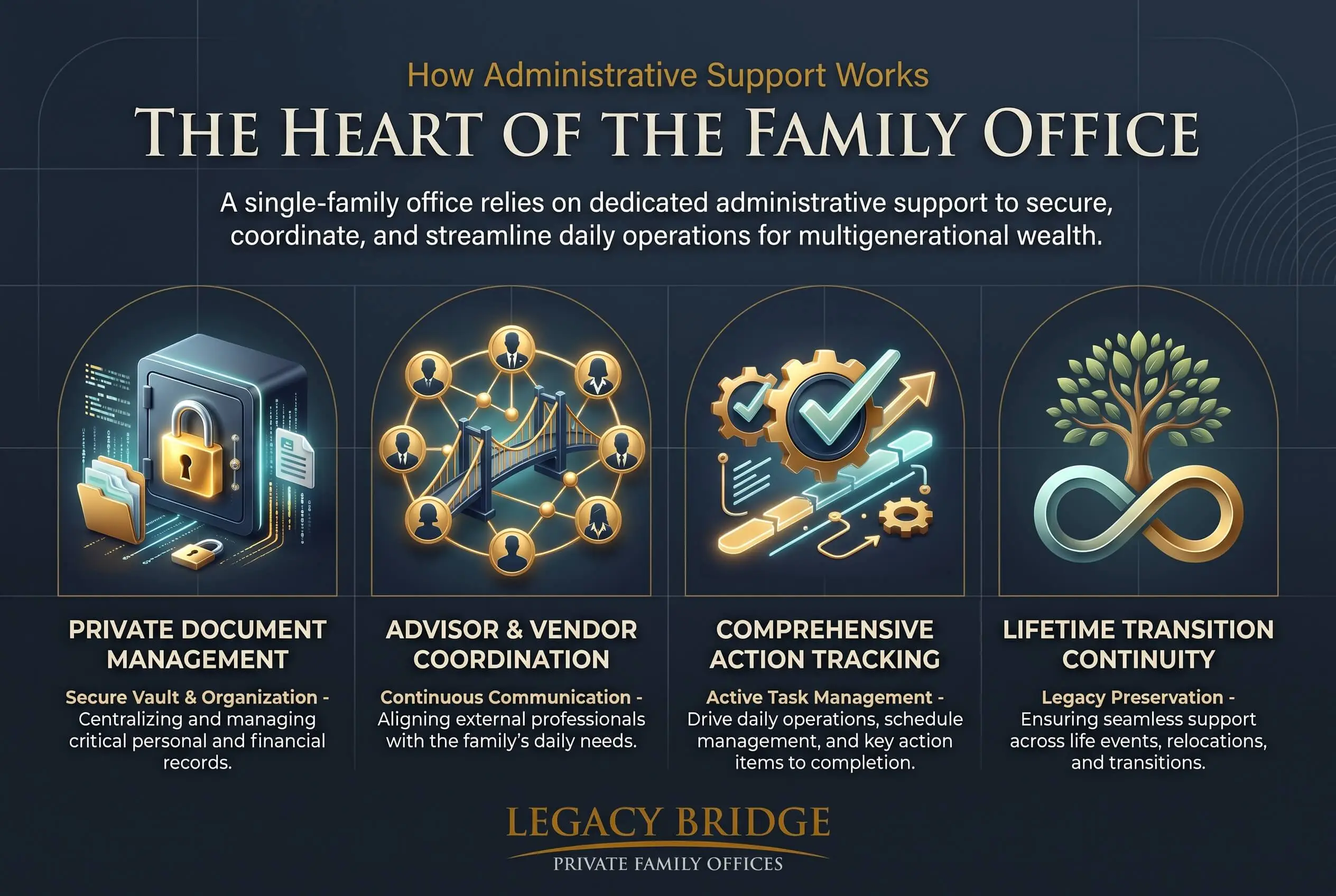
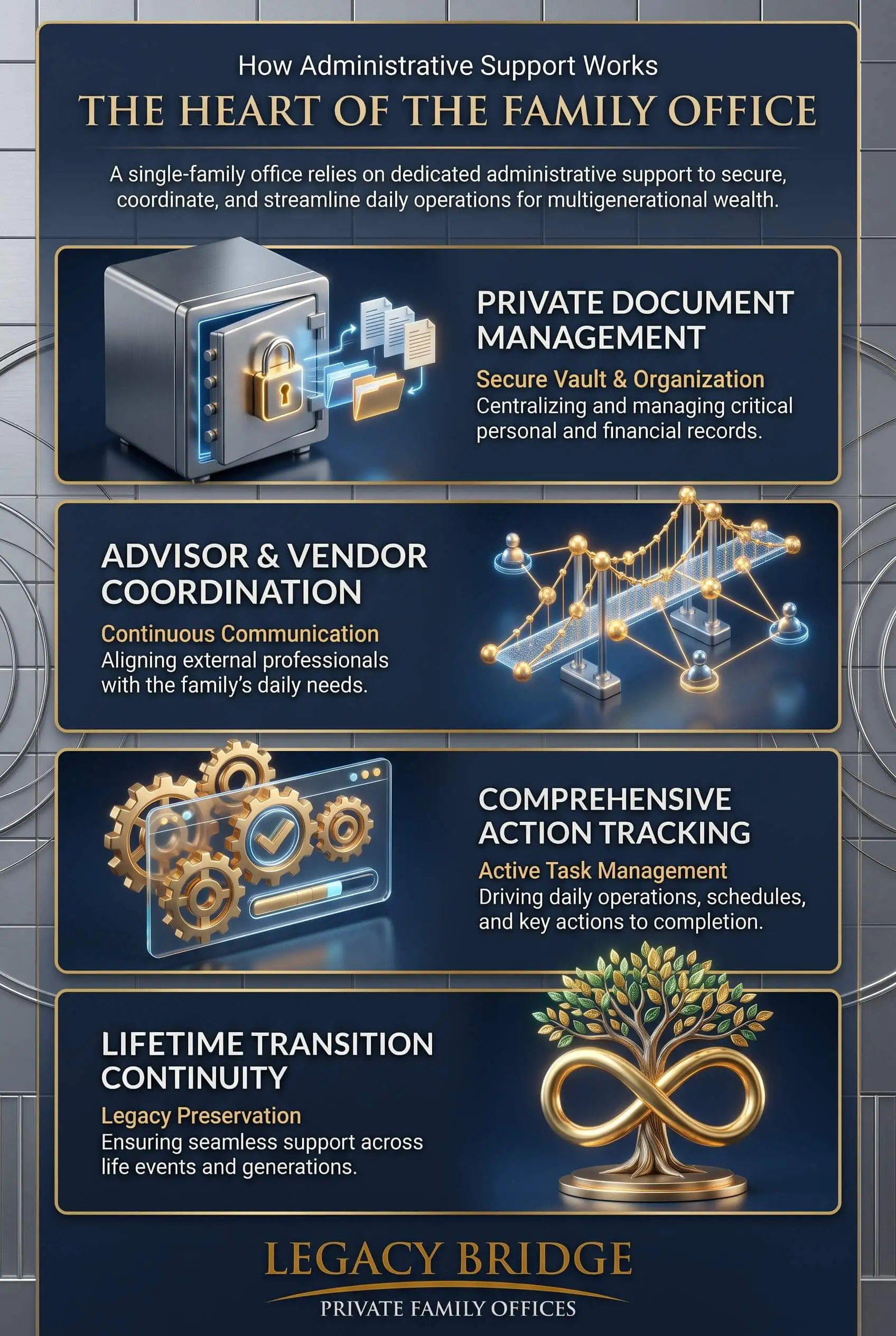
Family office administrative support is the system that keeps a family's documents, entities, advisors, and deadlines organized and moving, so the advice a family receives turns into finished work. One team owns a follow-through, and nothing important depends on one person's memory.
Document management: one secure source of truth for wills, trusts, titles, tax returns, and policies
Electronic vault: encrypted storage with multi-factor access and defined permissions
Entity continuity: current records for every LLC, trust, and partnership
Provider coordination: your CPA, estate attorney, and insurance broker working from shared context, with every action item tracked
Deadlines: renewals, filings, signatures, and notary needs on one calendar
It works alongside your existing advisors rather than replacing them. Legacy Bridge Private Family Offices, a boutique multi-family office in West Des Moines, Iowa, provides this structure for families who want a single-family office's administrative engine without building one.
Top Takeaways
Family office administrative support turns advice into finished work, from signed documents and funded trusts to paid bills and renewed policies.
When administration works, families get accountability, coordinated advisors, control over their records, and time back.
The core work covers document management, a secure vault, entity records, provider coordination, and calendars for renewals and signatures.
A single-family office can staff administration in-house, outsource it, or blend both, and continuity and security deserve as much weight as cost.
Every good system starts with an honest inventory of accounts, entities, documents, advisors, and recurring obligations.
Administrative Support Is the Engine of a Family Office
Administrative support in a single-family office is the system of people, processes, and secure tools that keeps a family's documents, entities, advisors, and deadlines organized and acted on. As a core part of family office services, your advisors make the recommendations, and administration is how those recommendations become signed documents, funded trusts, paid bills, and renewed policies.
When it works, families notice four things:
Accountability. One team owns each task until it's done.
Coordination. Your CPA, estate attorney, and insurance broker work from the same information.
Control. Records, permissions, and repeatable workflows replace scattered files and good intentions.
Time. Family members stop chasing details and spend their attention on decisions only they can make.
What Does Administrative Support Include in a Single-Family Office?
Every family's scope looks a little different. Most of the work falls into five areas.
Document Management and Recordkeeping
A family office needs one reliable source of truth. Estate documents, trust agreements, tax returns, titles, insurance policies, and entity records belong in one organized system with clear version control. When a life event arrives, nobody should be searching old email threads for the current version of a will.
Secure Vaulting and Access Permissions
Sensitive records belong in encrypted storage with multi-factor access. Deciding who sees what matters just as much. A spouse, an adult child, a CPA, and an estate attorney each need different access, and someone should review those permissions on a schedule instead of setting them once and forgetting about them.
Entity and Trust Record Continuity
Many families hold assets through several LLCs, partnerships, and trusts, each with its own operating agreement, minutes, annual filings, and registered agent. We keep those records current so an entity doesn't drift out of good standing while everyone assumes someone else is watching it.
Provider Coordination
A single-family office might work with a CPA, an estate attorney, two insurance brokers, a property manager, and several investment managers. Administration tracks each advisor's open items, gathers documents before tax season, and makes sure a decision made in one meeting reaches everyone it affects. Some families also start by outsourcing routine bookkeeping so in-house time goes to oversight.
Bills, Calendars, Renewals, and Signatures
This is the daily rhythm of the office. Bill pay oversight, insurance renewal dates, signing appointments, notary coordination for time-sensitive filings. None of it makes for good dinner conversation, and every piece of it gets expensive when it slips.
Who Does the Work Inside a Family Office
The classic office secretary handled correspondence, records, and the calendar. Today's family office administrator still does all of that, and the job has grown to include systems, permissions, and a bench of outside professionals.
In a fully staffed single-family office, the work usually sits with these roles:
Family office director or chief of staff. Sets priorities, owns operations, and serves as the family's main point of contact.
Office manager. Runs vendors, records, compliance calendars, and the day-to-day office.
Executive or administrative assistant. Handles scheduling, correspondence, travel, and document prep.
Staff accountant or bookkeeper. Manages bill pay, reconciliations, and reporting inputs.
Smaller offices combine these roles, and larger ones build teams under each. What holds it together in either case is one person who's clearly accountable for the whole picture.
How Administrative Support Works Day to Day
Good family office administration runs on a set process instead of reacting to whatever lands in the inbox that morning.
Clarify the full picture. Inventory every account, entity, property, document, advisor, and recurring obligation. Almost every family we work with finds gaps on the first pass.
Implement a disciplined system. Set up the document structure, access permissions, reporting cadence, and workflows around how the family actually makes decisions.
Coordinate and execute. Track every advisor's action items, keep deadlines on a shared calendar, and follow each task through to completion.
Maintain and improve. Review the system on a set schedule and update it after major life events, whether that's a new grandchild or a property sale.
Fragmented vs. Structured Administration
You can usually tell which kind of administration a family has by looking at five things.
Ownership. Fragmented: tasks spread across people and inboxes. Structured: one team accountable for follow-through.
Records. Fragmented: documents in multiple places with uneven access. Structured: centralized document management and a secure vault.
Coordination. Fragmented: a family member relays information between advisors. Structured: providers coordinated with shared context.
Security. Fragmented: permissions set once and rarely reviewed. Structured: defined permissions and consistent handling standards.
Family experience. Fragmented: reactive and time-consuming. Structured: proactive and dependable.
In-House Staff or Outsourced Support?
A single-family office can staff administration internally, hand it to an outside team, or blend the two. The right answer depends on complexity, privacy expectations, and how much fixed cost the family wants to carry.
Cost structure. In-house: salaries, benefits, technology, and office space. Outsourced: shared infrastructure and a lower fixed cost.
Control. In-house: direct, day-to-day oversight. Outsourced: defined processes, reporting, and service standards.
Continuity. In-house: exposed to turnover and key-person risk. Outsourced: team-based coverage with documented workflows.
Security. In-house: only as strong as what the office builds itself. Outsourced: established systems and handling standards.
Best fit. In-house: very large, highly complex family enterprises. Outsourced: families who want the engine without building the whole office.
Plenty of families land in the middle, with a trusted assistant in-house and an outside team running the system, the vault, and advisor coordination, including specialised needs such as family foundation management.
When Administrative Support Matters Most
Transitions are where administration proves its value. A business sale, an estate plan update, a move, a death or incapacity in the family, a new generation coming of age. Each one multiplies the documents and deadlines at once. If you're planning a business transition, get the administrative foundation in place before the deal rather than during it.
A family has usually outgrown informal administration when:
Important documents live across several inboxes and advisors' files
Advisors rarely talk to each other unless a family member connects them
An insurance renewal or entity filing has been missed, or nearly missed
Nobody can say with confidence who has access to what
Common Administrative Gaps We See
The same gaps show up in family after family.
No single source of truth. Three versions of the same trust agreement, and nobody is sure which one is current.
An unpaid family relay. One spouse or adult child ends up as the switchboard between every advisor.
Stale entity records. An LLC someone formed for one purpose years ago, with agreements no one has reread since.
Permissions nobody revisited. A former assistant or advisor who can still open sensitive files.
Renewals tracked in someone's head. Policies and deadlines that depend on one person remembering them.
"When a family first sits down with us, the advice they've received is rarely the problem. Most already have a good CPA, a capable estate attorney, and a sound investment plan. What's missing is the layer that turns those recommendations into finished work. We find trusts that were drafted and never funded, umbrella policies nobody has looked at since the house was bought, and LLCs whose minutes stop in a different decade. Usually one family member has been holding all of it together from memory, and they're tired. So we always start with an inventory, because you can't protect what you can't see. Once every document, entity, and advisor sits in one organized system, follow-through stops depending on who happens to remember."
7 Essential Resources
We point families to these when they start getting their administration in order. Read even two or three before your next advisor meeting and the conversation gets noticeably sharper.
1. RBC and Campden Wealth: See How North American Family Offices Actually Run
The North America Family Office Report 2026 surveyed 155 single-family and private multi-family offices. Its "Inside the Office" section breaks down operating costs, which services offices keep in-house, and why cybersecurity jumped to the top of the risk list this year.
2. J.P. Morgan Private Bank: Benchmark Costs, Staffing, and Outsourcing
J.P. Morgan's 2026 Global Family Office Report draws on 333 single-family offices in 30 countries. We find it most useful for seeing what families keep close, what they hand off, and how costs climb as an office grows more complex.
Source: https://privatebank.jpmorgan.com/nam/en/insights/reports/2026-family-office-report
3. Umbrex: Understand Typical Family Office Roles
This chapter of Umbrex's family office playbook maps leadership, finance, legal, and coordination roles, with sample structures for lean and fully staffed offices. It's a quick way to see where administrative work actually sits.
4. IRS: Know How Long to Keep Your Records
The IRS lays out how long to hold tax records, including the longer periods for property records. It's a simple starting point for building a retention policy into your document system.
Source: https://www.irs.gov/businesses/small-businesses-self-employed/how-long-should-i-keep-records
5. IRS Estate and Gift Taxes: Understand the Paperwork Behind Wealth Transfer
This hub covers estate and gift tax basics, filing requirements, and recent changes. Knowing what your estate attorney and CPA will ask for makes it far easier to keep the right records ready.
Source: https://www.irs.gov/businesses/small-businesses-self-employed/estate-and-gift-taxes
6. CISA: Put Basic Cyber Protections in Place
The Cybersecurity and Infrastructure Security Agency's guidance for small organizations covers multi-factor authentication, backups, and incident response plans. A family office with a handful of staff and a long list of advisors faces the same exposure.
Source: https://www.cisa.gov/cyber-guidance-small-businesses
7. Family Firm Institute: Find Advisors Who Specialize in Family Enterprise
FFI is a professional network for advisors who work with families of wealth and family businesses. Its education programs and publications help you vet specialists and see how the field approaches this work.
Source: https://www.ffi.org
These seven trusted resources from RBC, J.P. Morgan, Umbrex, the IRS, CISA, and the Family Firm Institute provide valuable guidance on family office administration, including staffing, outsourcing, document management, cybersecurity, tax compliance, and advisor coordination. They also highlight the importance of working with specialised service providers, from financial and legal advisors to a digital marketing agency supporting family-owned businesses, to keep operations organised, secure, and efficient.
3 Statistics
These numbers line up with what we hear in first meetings. Administration costs real money, it's under real security pressure, and most families are deciding what to keep close and what to hand off.
1. 59% of family offices now name cybersecurity and data breaches their top near-term operational concern
A year earlier, only 16% put it at the top.
In the same survey, 59% of offices had phishing attempts and 25% saw a family member's personal accounts breached.
Basic safeguards slipped anyway: two-factor authentication use fell from 92% to 83%, and dual payment authorization dropped from 84% to 73%.
Secure records, defined permissions, and payment controls have become core administrative work.
Source: RBC and Campden Wealth, The North America Family Office Report 2026
2. Administrative functions cost the median family office about $1 million a year
That's roughly the same as investment functions, inside a total median operating cost of about $2.75 million.
Bill pay is one of the services offices most often keep in-house, with 81% handling it internally.
For most single-family offices, administration ranks among the largest line items on the budget.
Source: RBC and Campden Wealth, The North America Family Office Report 2026
3. Family offices with more than $1 billion in assets now average over $6.6 million a year to run
J.P. Morgan reports that figure was $6.1 million in its 2024 report, with competition for talent driving much of the increase.
On average, about 26% of costs go to outside providers, and roughly 8 in 10 families outsource at least part of their investment portfolio.
Very few families build everything in-house anymore. What they're really deciding is which functions to own and which to trust to an outside team.
Source: J.P. Morgan Private Bank, 2026 Global Family Office Report
Final Thoughts and Opinion
Administration is where a family's plans either get carried out or quietly stall. Our honest view, after years of first meetings, is that most families already have good advice and struggle with follow-through, which is exactly the gap administrative support closes.
What We See Most Often
Strong advisors who rarely speak unless the family connects them
Estate documents the family signed but never fully put into effect, like a revocable trust with nothing titled to it
Entities and insurance policies that outlived the reasons the family set them up
One trusted person carrying the entire system in their head
Any of these can sit quietly for years. They tend to surface together during a sale, a health scare, or a death in the family, which is the worst possible time to sort them out.
What Actually Works
One source of truth. Every critical document lives in one secure, organized place with clear permissions.
One accountable coordinator. Someone owns every open item across every advisor until it's finished.
Our Perspective
Build the system before you need it. A single-family office doesn't have to hire a full administrative staff to get this right, and a family without a formal office doesn't have to go without it. Someone simply has to be responsible for the whole picture. The families we've watched move through transitions with the least stress were seldom the wealthiest or the most complex, but almost all of them were organized well before anything went wrong.
Frequently Asked Questions
What does family office administrative support include?
Family office administrative support includes document management, a secure electronic vault with defined permissions, entity and trust recordkeeping, and coordination with your outside advisors. It also covers the daily work of bill pay oversight, insurance renewals, and signature scheduling. The goal is one organized system where nothing important depends on someone's memory.
What does a family office administrator do day to day?
A family office administrator keeps the office running. They organize incoming documents, track advisor action items, manage calendars and renewals, coordinate signings, oversee payments, and keep records current. In larger offices, an office manager, assistants, and accounting staff split this work, usually under a director or chief of staff.
Does a single-family office need a full-time administrative team?
Not always. Very large or highly complex family enterprises can justify a full in-house team. Many families get the same result with a small internal presence and an outsourced or multi-family office team running the system, the vault, and advisor coordination. The right mix depends on complexity, privacy needs, and budget.
Can administrative support be outsourced without losing privacy or control?
Yes, as long as the provider uses secure systems and clear rules. Look for encrypted document storage, multi-factor access, set permission levels for each family member and advisor, documented workflows, and regular reporting. Good outsourced support should give you more visibility into your own affairs than you had before.
How do family offices keep sensitive documents secure?
They store critical records in encrypted systems with multi-factor authentication, grant access by role, and review permissions on a schedule. Well-run offices also use payment controls such as dual authorization and keep a written plan for what to do after a breach. Security holds up only when someone keeps maintaining it.
Does administrative support replace my CPA or estate attorney?
No. Administrative support works alongside your CPA, estate attorney, insurance broker, and investment managers. It keeps them aligned, gets them the documents they need, and tracks their action items to completion, so your advisors' recommendations actually happen.
How do we get started organizing our family office administration?
Start with a complete inventory of your accounts, entities, properties, documents, advisors, and recurring obligations. From there, set up a secure document structure, assign access permissions, and build a shared calendar for renewals and deadlines. Then name one person or team responsible for keeping all of it current.
Ready for Less Admin, More Life?
Every family office runs on details. The real question is whether yours live in one organized system or across a dozen inboxes and one tired family member's memory.
If your documents are scattered or your advisors rarely compare notes, start there. Schedule a private consultation with Legacy Bridge Private Family Offices, and we'll map your documents, providers, and recurring obligations, show you where the gaps are, and put a practical system in place for organization and follow-through through our family office concierge services. Your providers stay in their lanes. We keep the lanes connected and moving.


