Seventy-eight percent of family business executives expect a CEO transition within the next decade, according to Deloitte Private's February 2026 survey. Ask those same owners who will own the company afterward and what the family will live on, and the answers get much thinner.
That is the gap a business transition plan closes. It is a written roadmap for how ownership, leadership, and family wealth move when the founder steps back, sells, or can no longer lead. It also sets out how the family handles taxes and trusts, and how it will make decisions once the change is complete.
Most owners start with one question: "Who takes over?" The better question is, "What structure needs to exist before anyone does?"
TL;DR Quick Answers
Family Office Trust and Business Transition Services for Business Owners
The right family office trust and business transition services for business owners coordinate ownership, tax, trust, and family decisions before a sale or handoff, while there is still room to shape them. Here is what to look for:
Planning that starts before a Letter of Intent, while trust and tax options are still open
Close work with your estate attorney on trust design and funding
Tax modeling alongside your CPA, including state tax exposure
A post-transition liquidity plan and a written investment policy
Help with family governance and preparing the next generation
One accountable coordinator across every advisor involved
Legacy Bridge Private Family Offices, a boutique multi-family office in West Des Moines, Iowa, works with founders and business owners to build that structure. Acting as your Personal CFO, the team keeps the plan and the people behind it moving in the same direction.
Top Takeaways
A complete transition plan covers ownership, leadership, wealth and taxes, and family governance, not just who takes over.
Get trust, tax, and ownership planning moving before any buyer conversation or Letter of Intent.
Write down what "ready" means for a successor and who decides when they have met it.
Model after-tax proceeds and what the family needs to keep liquid before anything gets invested.
Put one coordinator in charge so your CPA, attorneys, and wealth advisor work from the same plan.
The Short Answer: A Transition Plan Is Four Plans in One
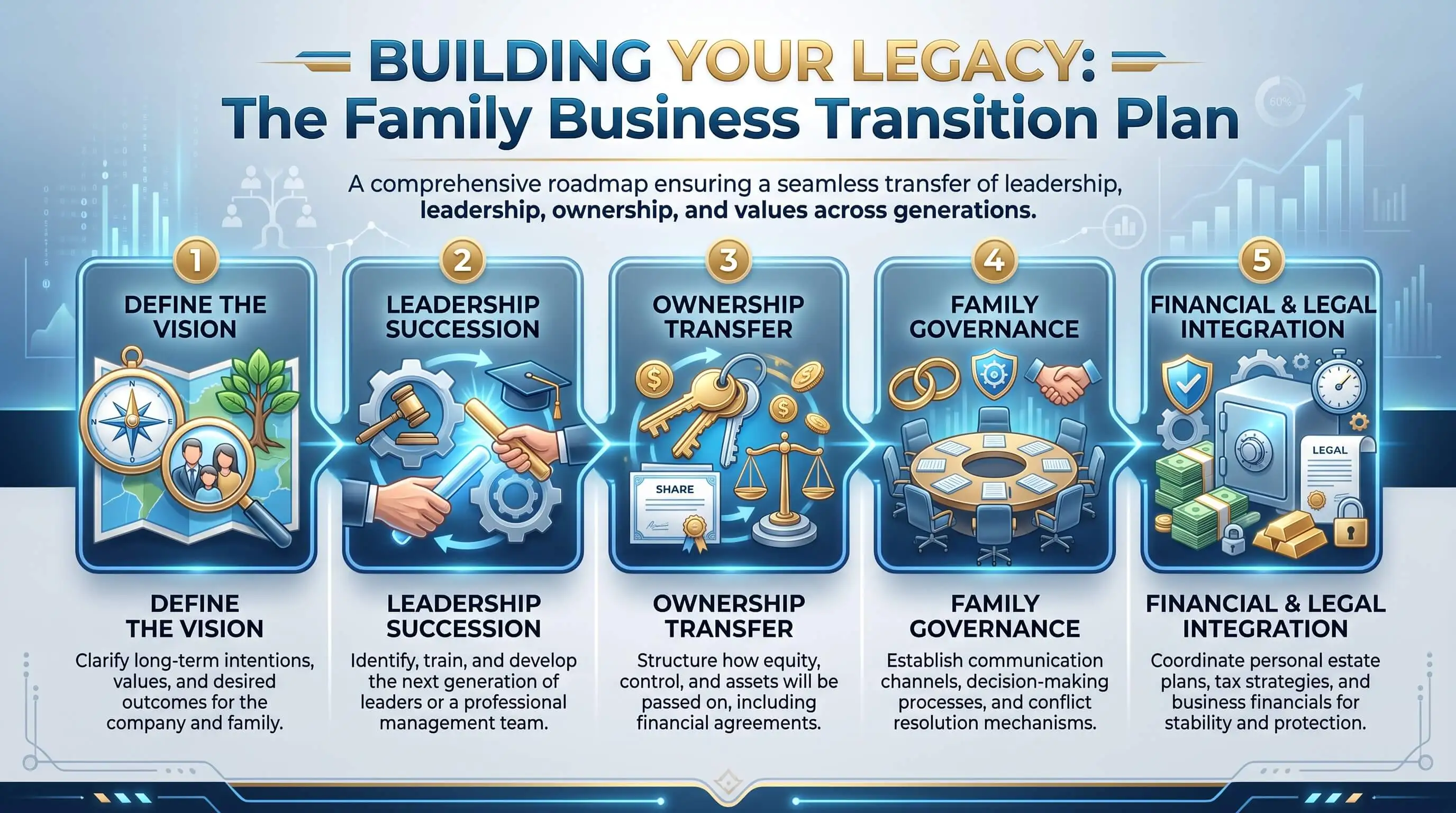
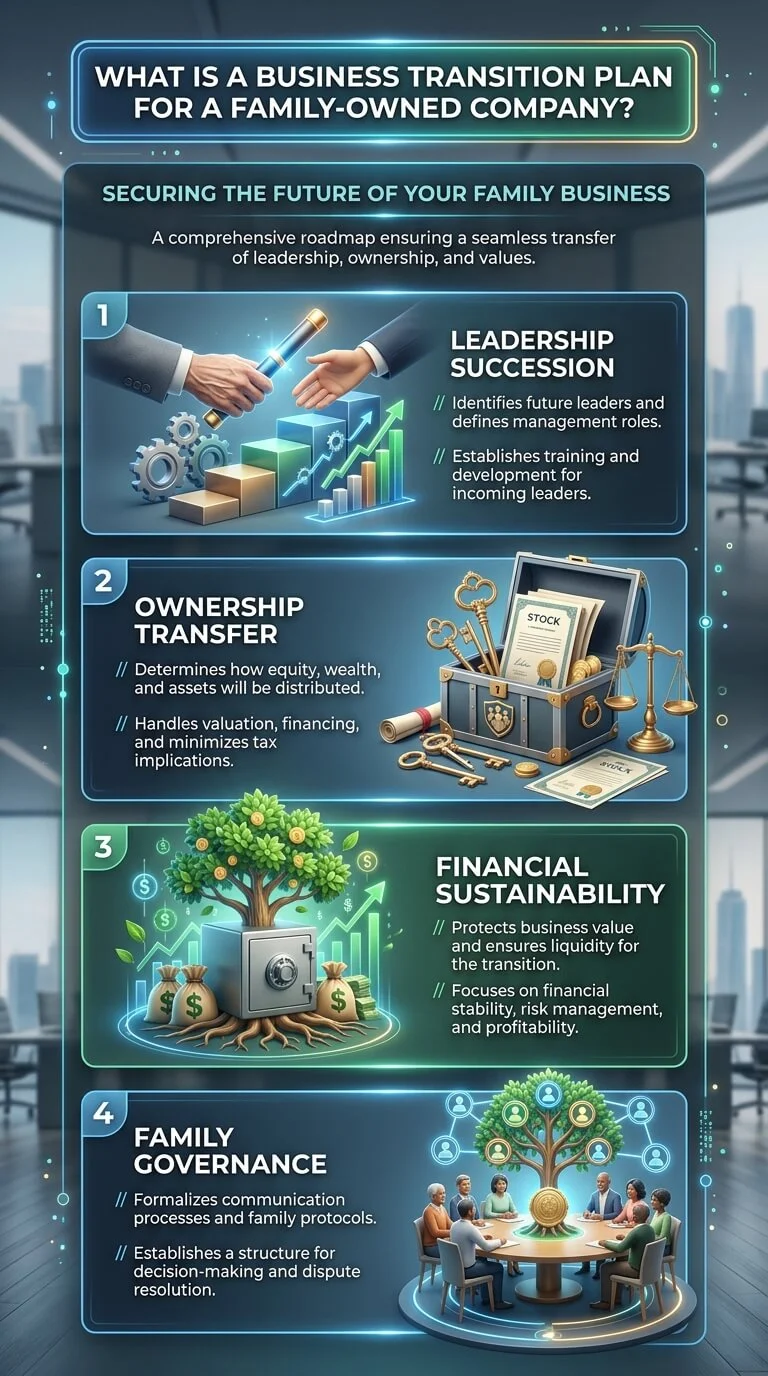
A family business transition plan answers four questions in one coordinated document: who will own the company, who will lead it, how the family will handle wealth and taxes, and how the family will make decisions together afterward. Succession planning addresses the leadership question, while transition planning addresses all four.
Ownership. Who holds the equity next, and whether it moves by gift, sale, trust, or a combination.
Leadership. Who runs the company, and how you will know they are ready.
Wealth, trusts, and taxes. How value leaves the business and reaches the family balance sheet without avoidable tax drag.
Family governance. How the family communicates, decides, and treats heirs who work in the business differently from those who do not.
Transition Planning vs. Succession Planning
Owners and advisors often use the two terms interchangeably. That habit is where many plans come up short.
Succession planning answers one question: who runs the company next?
Transition planning answers that question and keeps going. Who owns the company? What does the founder live on? Which trusts need funding, and when? What happens when a sibling who never worked in the business expects an equal share?
We regularly meet families with a capable, well-prepared successor and an ownership structure, estate plan, and set of family expectations that have not moved in a decade. On paper, the succession looks solid. The transition still turns difficult.
Ownership: Who Owns the Business Next and How It Transfers
Ownership decisions shape everything else in the plan, so start there. Most family companies follow one of four paths:
Transfer to family. Shares move to the next generation through gifting, a sale, trusts, or a combination.
Sale to management or employees. Key managers buy in over time, or the company sets up an employee stock ownership plan (ESOP).
Sale to an outside buyer. A strategic buyer or private equity firm acquires all or most of the business.
Partial sale or recapitalization. The family takes some liquidity off the table and keeps a stake.
Every path runs through documents that are often years out of date, including buy-sell agreements, operating agreements, shareholder agreements, and a valuation someone can defend. Buyers and heirs both need numbers they trust. Owners who keep clean, decision-ready books enter a transition with more options and far fewer surprises.
Leadership: Preparing a Successor Who Is Ready, Not Just Willing
Wanting the job and being ready for it are different things. Plenty of family businesses have a son, daughter, or nephew who wants the top seat. Very few have written down what "ready" means.
A strong leadership plan puts that standard in plain terms. It names the roles a successor should have held, the results they should have delivered, and who decides when they are prepared. It also looks past the successor to the people around them, because key employees and long-standing customer relationships can walk out the door during a messy handoff.
Continuity matters outside the building, too. When the face of the company changes, a documented brand voice helps customers keep hearing the same company under a new leader.
Wealth, Trusts, and Taxes: Planning the Family Balance Sheet
Owners tend to leave this part for last. It is usually where families lose the most value.
Timing is the reason. Before a Letter of Intent is signed, owners may still be able to move future appreciation outside their taxable estate through trusts or gifting. Once a deal is underway, valuations become harder to discount, and deal deadlines start making decisions for you. Depending on the facts, estate attorneys may evaluate grantor trusts, spousal lifetime access trusts, or charitable vehicles. Your own attorney and CPA should lead that work.
Then there is the simpler question founders often skip: what will the family actually live on? Answering it means modeling after-tax proceeds, setting tax reserves, and deciding how much must stay liquid before a single dollar is invested.
Family Governance: Keeping Priorities Aligned Across Generations
Your company has an org chart, job descriptions, and probably a board. Most families have none of those, and a transition exposes the gap quickly.
Governance does not have to be formal to work. It usually starts with regular family meetings and grows into a written family statement or a family council as the wealth and the family get larger. The hardest conversation tends to be about fairness. Equal is not always fair when one child has spent 15 years running operations and another has never set foot in the plant. Talk those expectations through and write them down before the transition, while everyone is still at the same table.
When Should a Family Business Start Transition Planning?
Earlier than feels necessary. Each part of the plan runs on its own clock:
Leadership: 5 to 10 years before the expected handoff, so a successor has time to develop and prove themselves.
Ownership, trusts, and taxes: well before any buyer conversation or Letter of Intent, while the options are still open.
Family governance: now. Communication habits take years to build.
Most owners already sense this. In Deloitte Private's February 2026 survey, 30% of family business executives said their succession planning was behind schedule.
Time is leverage. No advisor can hand it back to you later.
Where a Family Office Fits in the Transition
A family office is a private advisory structure that manages a family's broader financial life, including investments, taxes, trusts, estate planning, and governance. During a business transition, its most practical job is coordination.
A typical transition pulls in a CPA, an estate attorney, an M&A attorney, an investment banker, and a wealth advisor. Each may be excellent at what they do. The problem is alignment. When the founder ends up playing telephone between them, details slip: a trust misses its funding window, a tax estimate overlooks the deal structure, or the estate plan still describes a company the family no longer owns.
Family office trust and business transition services for business owners exist to close that gap. A Personal CFO acts as the quarterback and single point of accountability, using outsourced family office executive services to keep every advisor working from one plan so the owner can run the business and close the right deal on the right terms.
Common Transition Planning Mistakes
Letting an event set the timeline. A health scare, an unsolicited offer, or plain burnout forces decisions the owner should have made years earlier.
Confusing a willing heir with a ready one. Twenty years of working beside the founder is not a training plan.
Planning the deal but not the proceeds. The wire lands, and no investment policy, tax reserve, or spending plan is waiting for it.
Letting advisors work in silos. Good professionals can still produce a plan that contradicts itself.
Avoiding the family conversation. When nobody talks at home, people fill the silence with assumptions, and those assumptions turn into conflict.
"In our work with business owners, the transaction itself is rarely what goes wrong. Founders know how to run a process, hire good bankers, and negotiate hard. The trouble sits around the deal. We find trusts that should have been funded two years earlier and estate plans that still describe a company the family is about to sell. Sometimes an heir has assumed a role nobody ever defined. By the time a Letter of Intent is on the table, the best planning options have often narrowed. So we tell owners to build the family's structure first, while time is still on their side, and let the transition happen inside it."
7 Essential Resources
We send owners to these whether a transition is ten years out or already on the calendar. Each one covers a piece of the plan worth understanding before you sit down with your advisors.
1. Deloitte Private: See How Other Family Businesses Are Handling Succession
Deloitte's 2026 global report draws on a survey of 1,587 family businesses plus interviews with senior executives. It shows where succession plans tend to fall short and how families are getting the next generation ready to lead.
2. U.S. Chamber of Commerce CO-: Get a Plain-Language Primer on Succession
This short overview covers how family businesses approach succession planning and why the plan needs to exist before the company needs it.
Source: https://www.uschamber.com/co/start/strategy/family-business-succession-planning
3. U.S. Small Business Administration: Understand Your Transfer and Exit Options
The SBA walks through transferring ownership, selling, and closing a business. Its checklists cover the legal and tax loose ends each path leaves behind.
Source: https://www.sba.gov/business-guide/manage-your-business/close-or-sell-your-business
4. IRS Estate and Gift Taxes: Know the Federal Rules Behind Ownership Transfers
The IRS hub explains how transfers during life and at death are taxed, with FAQs and filing guidance. Reading it before your next meeting with your estate attorney or CPA will make that conversation more productive.
Source: https://www.irs.gov/businesses/small-businesses-self-employed/estate-and-gift-taxes
5. Family Firm Institute: Find Advisors Who Specialize in Family Enterprise
FFI is a professional association for the advisors, consultants, and researchers who work with family businesses. Its programs and its journal, Family Business Review, are a good way to vet specialists and see how the field thinks about transitions.
Source: https://www.ffi.org
6. Exit Planning Institute: Measure How Ready You Really Are
EPI's State of Owner Readiness research compares how prepared owners feel with how prepared their businesses and personal finances actually are. Estate plans, it turns out, lag behind more often than owners expect.
Source: https://exit-planning-institute.org/state-of-owner-readiness
7. PwC US Family Business Survey: Benchmark Governance and Succession
PwC's long-running survey covers purpose, governance, and succession in U.S. family businesses, and it shows how those firms compare with family businesses worldwide.
Together, these give you the background to build a plan on your own timeline rather than a buyer's.
3 Statistics
These numbers match what we hear on first calls with owners. Nearly every owner knows a transition is coming. Far fewer have a plan that reaches the whole family balance sheet.
1. 78% of family business executives expect a CEO transition within the next decade
Deloitte Private surveyed 300 family business executives in February 2026, and 42% of them expect that change within three to five years.
While 85% call succession planning critical, only 57% have an established plan, just 23% are actively carrying one out, and 30% admit they are behind schedule.
For most families, the transition is already on the calendar even when the plan isn't.
2. Succession planning affected 44% of U.S. family firms in a single year
PwC's 2025 US Family Business Survey found that succession touched 44% of U.S. family businesses in the prior year.
Globally, the figure was 34%.
U.S. owners are dealing with this now, well before retirement is on the horizon.
Source: PwC, US Family Business Survey 2025
3. Only 27% of family businesses have a fully structured succession plan
The First Bank Center for Family-Owned Businesses reported this in its 2023 survey.
Family-owned businesses employ nearly 62% of the U.S. workforce, or about 82 million people.
When a family business transition goes badly, the family is not the only one that feels it. Employees and whole communities do, too.
Source: First Bank Center for Family-Owned Businesses via Business Wire (2023)
Final Thoughts and Opinion
A family business transition is the point where responsibility moves from the company to the family balance sheet, which is why we never treat it as a finish line. Our honest view is that most owners plan the handoff carefully and underestimate everything that has to be in place to receive it.
What We See Most Often
Estate plans written when the company was worth a fraction of its value today
Successors who have been "in training" for years without a written standard for readiness
Advisors who each do good work but have never sat in the same meeting
Families who have never talked openly about who owns what, or why
Any one of these can wait a while. Together, they tend to surface in the same week, usually the week a buyer calls or a health event forces the timeline.
What Actually Works
Building structure before the deal. Trust funding, entity cleanup, and tax modeling happen while the options are still open.
Running one plan with one coordinator. Every advisor works from the same roadmap, and someone is accountable for keeping it current.
Our Perspective
Start earlier than feels necessary. If your ownership, leadership, wealth, and family plans all point the same direction, you are in a strong position. If you cannot name which advisor owns each piece, begin there. The owners we've seen handle transitions best rarely had the biggest exits, but almost all of them built the structure first.
Frequently Asked Questions
What should a family business transition plan include?
A complete plan covers four areas: who will own the business, who will lead it, how wealth, trusts, and taxes will be handled, and how the family will make decisions together. It should also include a timeline, current buy-sell and operating agreements, and a clear note of which advisor owns each workstream.
What is the difference between succession planning and transition planning?
Succession planning focuses on who runs the company next. Transition planning goes further and covers ownership transfer, estate and tax strategy, the founder's income after the change, and family governance. A business can have a strong successor and still struggle through the transition if those other pieces are missing.
How far in advance should a family business start transition planning?
For leadership, aim for 5 to 10 years before the expected handoff. Ownership and tax planning should start well before any buyer conversation, because some trust and gifting options can get harder to use once a Letter of Intent is signed. Family governance can start anytime, and sooner is better.
How are trusts used when transferring a family business?
Trusts may let owners move shares, along with future growth in their value, outside the taxable estate while setting rules for how heirs benefit. Depending on the facts, attorneys may consider grantor trusts, spousal lifetime access trusts, or charitable vehicles. The right structure depends on your goals, and your own attorney and CPA should design it.
How does a family office help with a business transition?
A family office coordinates the personal side of the transition, including taxes, trusts, estate planning, liquidity, investments, and family communication. Its biggest value is keeping your CPA, estate attorney, M&A attorney, and wealth advisor on one plan, so you are not left relaying details between them during the busiest months of the process.
Should the next generation be involved in transition planning?
In most cases, yes. Bringing heirs in early helps them understand the business and the wealth it created, and it brings expectations to the surface before they turn into conflict. Family members who work in the business may need a bigger role than those who do not, but both groups benefit from knowing the plan.
What happens to a family business if the owner has no transition plan?
A death, disability, or unexpected offer can force rushed decisions about ownership, leadership, and taxes. Heirs may inherit shares with no agreement on who runs the company, and the estate may face tax exposure that planning could have reduced. Some families end up selling under pressure rather than on their own terms.
Build the Plan Before the Transition Builds It for You
Every family business changes hands eventually. What you can still decide is whether your family's structure is ready when it happens.
If no one has reviewed your ownership, estate, tax, and family plans side by side, start there. Schedule a private consultation with Legacy Bridge Private Family Offices. We will look at where your plan stands today, where the gaps are, and where virtual outsourced finance and accounting services can support what needs to happen before the next chapter begins. The window before a transition is the highest-leverage planning time you will have. Let us help you use it well.