A daughter runs the family company for 15 years and assumes her share of the estate will reflect it. Her brother, who never worked there, assumes everything will be split equally. Neither has heard their parents say a word about it. In our experience, most family wealth disputes begin in a silence like that one, long before anyone reads a will.
Families will face that silence more often in the years ahead. Cerulli Associates projects that $124 trillion will transfer in the United States through 2048, and $105 trillion of it is headed to heirs.
So can a multi-family office prevent family wealth disputes? No firm can promise a family will never disagree, and we would be cautious about any firm that does. What the right multi family office services can do is remove the conditions that turn a disagreement into a dispute: expectations nobody has said out loud, heirs who were never prepared, roles nobody defined, and advisors who have never compared notes.
Most families ask whether they will argue about this someday. The better question is whether they have a structure for deciding together when they do.
TL;DR Quick Answers
Multi Family Office Services
Multi family office services give an affluent family one coordinated team for its entire financial life, starting with the full balance sheet instead of the investment account. Every advisor works from the same plan, and family members no longer carry messages between specialists. For families worried about disputes, that coordination is the point.
Family governance: structured family meetings, a written family constitution, and clear decision rules
Next-generation education: heirs learn how the trusts, investments, and estate plan work before they inherit
Trust and estate coordination: trustees, beneficiaries, and the estate attorney work from the same information
Personal CFO: one point of accountability for cash flow, deadlines, and advisor follow-through
Tax coordination: year-round planning alongside the family's CPA, not only at filing time
Investment oversight: asset allocation, liquidity, and risk managed across accounts, trusts, and entities
Philanthropy: shared giving that doubles as practice in deciding together
Reporting and administration: consolidated reporting and organized documents, with fewer dropped balls
Who it fits: families with significant, complex wealth. Legacy Bridge Private Family Offices, an independent, SEC-registered fiduciary in West Des Moines, Iowa, serves families managing $10 million or more.
Top Takeaways
A multi-family office cannot stop every disagreement, but it can remove the conditions that turn disagreements into disputes.
Most family wealth disputes trace back to silence and a sense of unfairness, far more often than to greed.
Structured family meetings, a written family constitution, and education for heirs do most of the preventive work.
With one coordinator across your attorney, CPA, and trustee, family members stop carrying messages and taking sides.
Governance built in a calm year holds up far better than governance pieced together after a death or a sale.
The Short Answer: A Multi-Family Office Addresses the Causes of Conflict
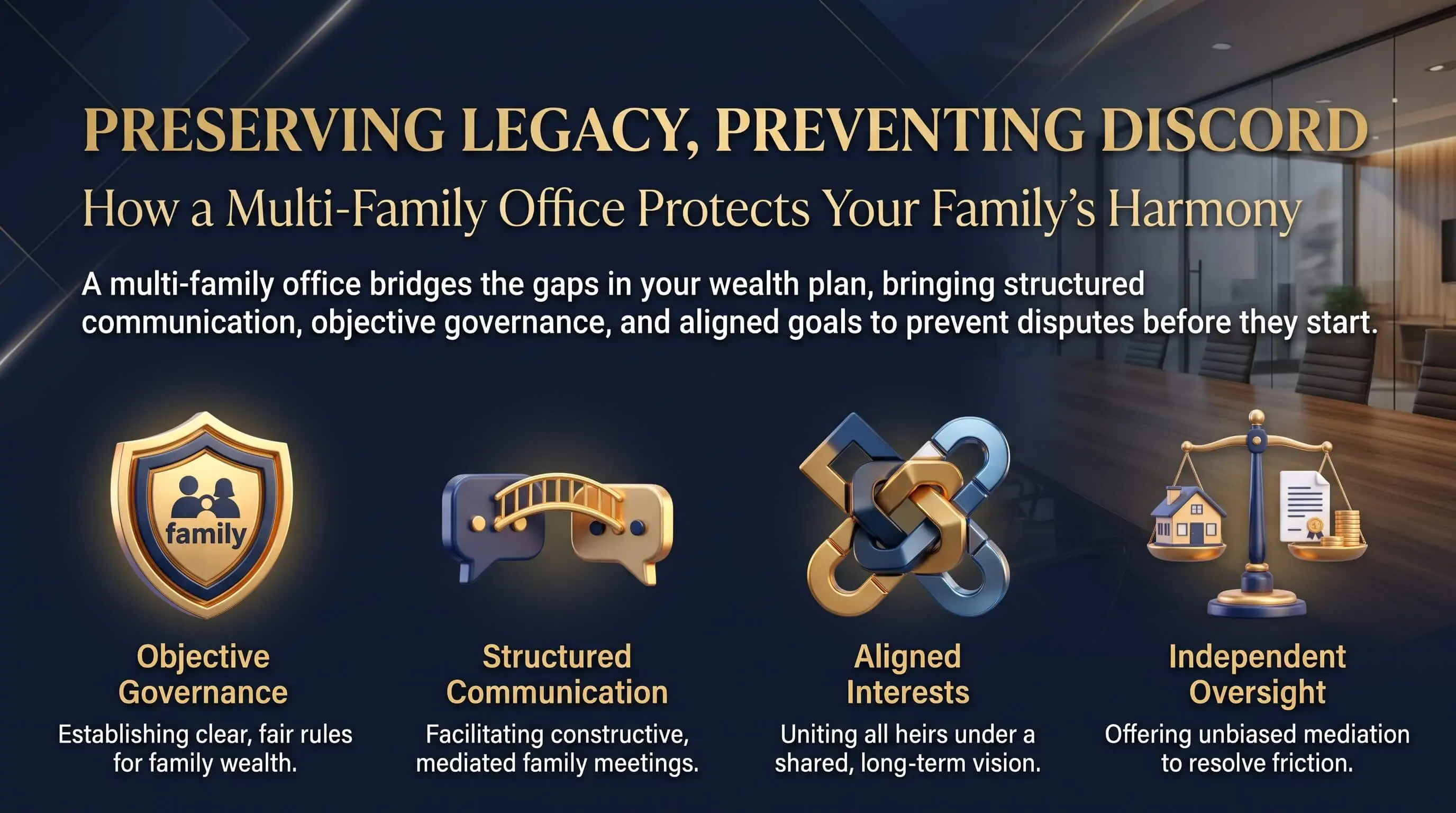
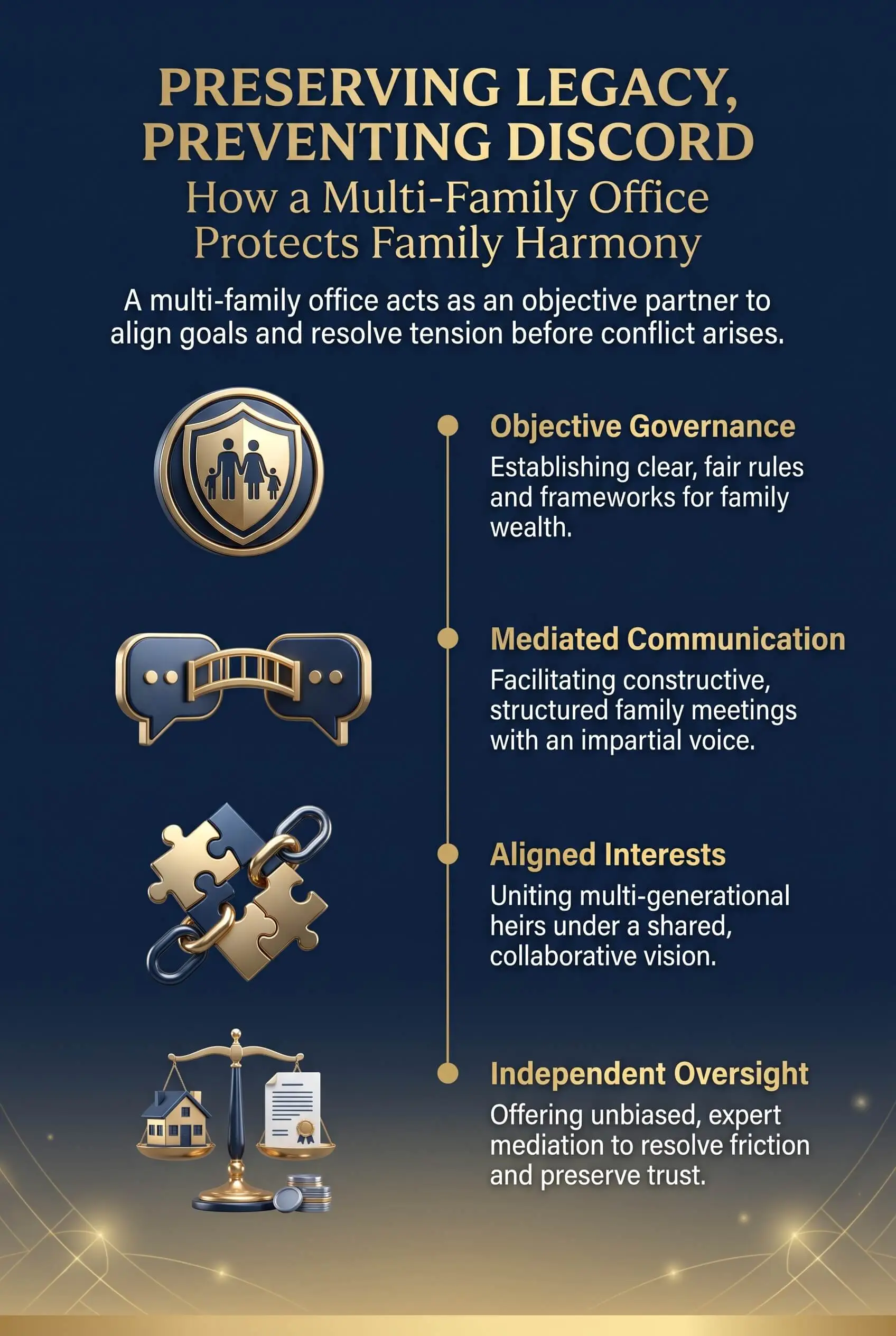
A multi-family office cannot keep relatives from disagreeing. What it can do is take on most of the conditions that turn disagreement into a dispute. The tools are family governance, structured family meetings, education for heirs, trust coordination, and one accountable team that keeps every advisor working from the same plan.
A multi-family office (MFO) is an independent advisory firm that serves several affluent families through one shared, coordinated team. Traditional wealth management often begins with investments. A multi-family office begins with the full picture, including trusts, tax and estate coordination, philanthropy, reporting, and family governance. Governance is where most dispute prevention happens.
What Actually Causes Family Wealth Disputes?
Almost every family wealth dispute we have seen traces back to a short list of triggers, and nearly all of them are about expectations. When we meet a family for the first time, one or two of these are usually already in motion.
No one knows the plan. Heirs learn the terms of the estate at the reading of the will. Regular family meetings and plain-language estate education close that gap years earlier.
Equal versus fair. One child has run the business for 15 years, and another has never worked there. A family constitution settles what fairness means before anyone tests it.
Unclear roles in a family business. A successor assumes control that nobody formally granted. Writing those roles down, and tying them to a family business transition plan, removes the guesswork.
Trustee and beneficiary friction. Beneficiaries take distribution decisions personally. Trust coordination and steady communication keep those decisions from arriving as surprises.
Blended families and surviving spouses. A surviving spouse and stepchildren often expect very different outcomes. Documented conversations about intentions, held while everyone can still ask questions, narrow that distance.
Advisors giving conflicting advice. The CPA, the estate attorney, and the wealth advisor each give sound guidance that does not quite fit together. One coordinator puts all of it on a single shared plan.
Heirs unprepared to receive wealth. A first-time inheritor makes fast decisions with very little context. Education that starts years ahead gives them that context.
Greed shows up less often than people expect. Far more often, someone felt surprised or left out, and the family had no agreed way to raise it.
How Multi Family Office Services Defuse Conflict Before It Starts
Multi family office services put structure where most families rely on goodwill. Goodwill matters. It also wears thin quickly after a parent passes or a business sells.
Family Governance and Structured Family Meetings
A family meeting works when someone neutral runs it from a written agenda and sends action items afterward. Without that, meetings drift toward polite small talk or old grievances. We handle the logistics and keep the conversation on decisions. Then we follow up, so the progress the family made in the room continues after everyone goes home.
A Family Constitution
A family constitution is a written statement of the family's values, roles, and decision rules. It answers in a calm year the questions that would be painful to answer in a hard one, such as how heirs who work in the business are treated compared with those who do not, or how someone raises a concern without starting a confrontation. Most family constitutions are not legally binding, and they do not need to be. They carry weight because the family wrote them together.
Next-Generation Education
An heir who understands how a trust works is far less likely to read a distribution decision as a personal judgment. We walk the next generation through the purpose and structure of the estate plan, the basics of investing, and how the family makes decisions. That education also lowers anxiety, because younger family members who understand the structure around the wealth stop filling the silence with their own assumptions.
Trust Coordination and Beneficiary Communication
Trusts are one of the most common settings for family conflict, because they separate the people who control assets from the people who benefit from them. An MFO keeps trustees, beneficiaries, attorneys, and CPAs working from the same information. It tracks distribution needs and explains decisions before they land.
One Coordinator Across Every Advisor
When advisors work in silos, family members become the messengers, and messages change in the retelling. A Personal CFO gives the family one point of accountability who keeps the estate attorney, CPA, trustee, and investment team aligned. The family should not have to serve as the messenger between specialists. Fewer conflicting recommendations also leave fewer reasons for anyone to take sides.
Shared Philanthropy as Practice
A donor-advised fund or family foundation gives relatives a lower-stakes place to practice deciding together. Choosing which causes to support builds the habits a family will need later for bigger decisions, especially listening and following a process everyone agreed to in advance.
What a Multi-Family Office Cannot Do
A multi-family office is not a family therapist, a mediator, or a litigator. When relationships are already badly strained, a professional mediator or family counselor is often the right first step, and the MFO works alongside them. Where legal rights are in question, the family's own estate attorney leads.
Governance also depends on participation. We can build the framework, schedule the meetings, and prepare the materials, but we cannot make anyone attend. In our experience, most people come around once they see the process is fair and that what they say is actually written down.
Single-Family Office or Multi-Family Office: Which Helps More With Family Conflict?
Both can support family governance. A multi-family office often has the edge on neutrality, though. Single-family office staff are employees of one family, which can leave them in an awkward spot when branches of that family disagree. Multi-family office advisors sit outside the family and serve several families, and at an independent fiduciary firm they are bound to act in the client's interest. That outside position makes it easier to lead a hard conversation without looking like anyone's ally.
Signs Your Family Needs Structure Before the Next Transition
If two or more of these sound familiar, it is a good time to put governance in place:
Your family has not met to discuss wealth or the estate plan in the past year.
You signed your estate plan when the business or portfolio was worth far less than it is today.
A business sale or retirement is on the calendar.
Your adult children have never read the trust documents that affect them.
One branch of the family works in the business and another does not.
Your attorney, CPA, and wealth advisor have never been in the same meeting.
"People picture a family wealth dispute as something that erupts at the reading of a will. In our work, it almost never begins there. It begins ten years earlier, when a parent decides it would be kinder not to explain how the estate is divided, or when one child quietly takes on more of the business and nobody says what that means for ownership. By the time a family calls us, the facts are usually manageable. The assumptions are what hurt. So the first thing we do is bring the plan into the room, in plain language, with everyone who will have to live with it. A good family meeting will not end every disagreement, but it does make sure nobody is caught off guard."
7 Essential Resources
These are the sources we hand families before their first governance meeting. Each one shows a different side of how disputes start and what keeps them from starting.
1. Cerulli Associates: Understand the Size of the Coming Transfer
Cerulli projects how much wealth will pass to heirs, spouses, and charities through 2048. The same release reports that 89% of the high-net-worth firms Cerulli surveyed in 2024 consider family meetings and regular family communication a key best practice.
2. UBS Global Family Office Report 2025: See How Wealthy Families Handle Succession
UBS surveyed 317 family offices between January and April 2025. Its succession findings show how often families build a plan without asking the generation that will inherit it.
3. STEP: Learn What Estate Practitioners See Behind Inheritance Disputes
The Society of Trust and Estate Practitioners asked its members where family conflict comes from. Their answers point to blended families and unequal treatment of siblings, with poor communication underneath nearly all of it.
4. RBC Wealth Management: Get a Plain-Language View of Family Constitutions and Councils
RBC explains how families structure an office and why a family constitution and council can help resolve disputes. If governance is new to your family, start here.
5. Morgan Lewis: Compare Family Office Models Side by Side
This July 2026 analysis compares single-family, multi-family, outsourced, and hybrid offices on cost, control, and governance. Its most useful point for families is that complexity, more than asset size, should decide the model.
6. SEC Investment Adviser Public Disclosure: Check a Firm Before You Trust It
Neutrality matters when an advisor sits between family members. The SEC's free database shows whether a multi-family office is a registered investment adviser and lets you read its Form ADV.
Source: https://adviserinfo.sec.gov/
7. IRS: Learn How Donor-Advised Funds Work
Shared giving is one of the easiest places for a family to practice making decisions together. The IRS overview covers how donor-advised funds are set up and who controls the money once it is given.
Source: https://www.irs.gov/charities-non-profits/charitable-organizations/donor-advised-funds
Read a few of these resources on family office services before your next family meeting, and the conversation starts from shared facts instead of assumptions.
3 Statistics
These numbers match what we hear in first meetings. Families know a transfer is coming, and far fewer have talked it through with the people on the receiving end.
1. $124 trillion will transfer through 2048
Cerulli Associates projects that $105 trillion of it will go to heirs and $18 trillion to charity.
Before reaching heirs, $54 trillion is expected to pass to surviving spouses, a common point of friction in blended families.
The largest transfer of wealth in U.S. history has already started, and every handoff is a moment when expectations can collide.
2. Only 26% of family offices consulted the next generation about the succession plan from the outset
UBS found that just 53% of the 317 family offices it surveyed have a wealth succession plan for family members.
43% called preparing the next generation to take on wealth responsibly a major challenge.
Even very wealthy families tend to plan around their heirs instead of with them.
Source: UBS, Global Family Office Report 2025 (May 2025)
3. 68% of estate practitioners name conflict between children and a surviving parent or stepparent as the top source of disputes
In STEP's research, 37% pointed to unequal treatment of siblings.
In the same UK-based research, 80% of adults said their family does not know their wishes for when they die, and only 16% had talked those wishes over with loved ones.
The triggers are predictable, and a family can plan for predictable problems.
Source: Financial Planning Today, reporting STEP research (May 2026)
These statistics highlight the growing challenges of wealth transfer, succession planning, and family inheritance disputes. A digital marketing agency can help financial advisory firms communicate the importance of early planning, next-generation involvement, and clear family discussions to families preparing for wealth transitions.
Final Thoughts and Opinion
In our view, families rarely fight about the money itself. They fight about fairness and about being surprised. A multi-family office earns its place by making both less likely, well before anyone opens an estate plan in a season of grief.
What We See Most Often
Estate plans that made sense when the family signed them but that no one ever explained to the people they affect
Heirs who work in the family business and heirs who do not, each with a different idea of what is fair
Trustees and beneficiaries who only talk when a distribution is denied
Advisors who each do good work but have never compared notes
Any one of these can be handled. When several sit untouched for years, they tend to surface together in the same hard stretch, usually right after a death or a sale.
What Actually Works
Talking early. A family meeting held in a calm year does more than any document drafted during a crisis, especially once the family writes its agreements into a constitution people can point back to.
Naming one coordinator. When a single team keeps every advisor on the same plan, family members can stop relaying messages and start making decisions.
Our Perspective
No structure guarantees harmony, and we would question anyone who claims otherwise. What structure gives a family is a place to take disagreement other than a courtroom. The families we have watched hold together across generations still disagreed. The difference was that they had agreed, in advance, on how they would work it out.
Frequently Asked Questions
Can a multi-family office stop family members from fighting over money?
Not entirely, and no responsible firm should promise that. A multi-family office reduces the most common causes of conflict, such as unspoken expectations, unprepared heirs, unclear roles, and advisors who send mixed messages. Families with a governance process in place tend to work out disagreements in meetings and under agreed rules instead of through attorneys.
What causes most family wealth disputes?
Most disputes grow out of expectations, not dollar amounts. Common triggers include heirs learning the estate plan too late, disagreement over equal versus fair treatment, tension between a surviving spouse and children or stepchildren, unclear roles in a family business, and friction between trustees and beneficiaries.
What multi family office services help prevent conflict?
The services that matter most are family governance support, structured family meetings, a written family constitution, wealth education for the next generation, trust coordination, and a single coordinator who keeps the family's attorney, CPA, trustee, and investment team aligned. Shared philanthropy also gives families a place to practice deciding together.
What is a family constitution, and is it legally binding?
A family constitution is a written statement of a family's values, roles, and decision rules. On its own it usually is not legally binding, although it may refer to documents that are, such as trusts or shareholder agreements. Its value comes from the fact that family members wrote it together and agreed to follow it.
Does a multi-family office replace our estate attorney or a mediator?
No. A multi-family office works alongside your estate attorney, CPA, and trustee and does not take their place. When relationships are already strained, a professional mediator or family counselor may be the right first step, with the multi-family office supporting the process and keeping the financial picture organized.
Should heirs be part of wealth planning conversations?
In most cases, yes. Heirs who understand the structure and purpose of the estate plan are less likely to take decisions personally. UBS found that only 26% of family offices consulted the next generation about the succession plan from the outset, which leaves many heirs learning the plan once it is too late to ask questions.
How much wealth does a family need to work with a multi-family office?
Many multi-family offices serve families with $25 million or more in investable assets. Legacy Bridge Private Family Offices works with families managing $10 million or more and decides fit based on the complexity of the family's balance sheet, entities, and generations instead of a single threshold.
Give Your Family a Framework Before It Needs One
Every family disagrees eventually. You can still decide whether that disagreement has somewhere productive to go.
If your family has never sat down together to talk through the estate plan, the trusts, and who is expected to do what, start with that conversation. Schedule a private consultation with Legacy Bridge Private Family Offices. We will look at where your family's planning stands today and where expectations may be drifting apart, then recommend the structure that would keep everyone working from the same plan. One call. One team. One coordinated strategy for keeping your family's wealth, and your family, together.


