In the first quarter of 2025, online retailers spent less than 1% of their digital ad budgets on Spanish-language websites, according to Nielsen data reported by TheDesk. That single number explains a lot about why multicultural campaigns stall. Some brands never reach the communities they hope to win. Others reach them with work that was never made for them.
Those are two different problems with two different fixes. When people in your target communities see your ads and do not respond, the gap is usually creative. When the right people never see the ads at all, the gap is media.
Top multicultural marketing agencies begin every engagement by sorting out which of those problems a brand actually has. A minority-owned multicultural advertising agency whose team already lives inside the communities you want to reach can usually tell within a few conversations whether the message or the media is falling short.
TL;DR Quick Answers
Top Multicultural Marketing Agencies
The top multicultural marketing agencies diagnose whether a brand has a message gap or a media gap before they recommend a single service. Look for five traits:
In-culture talent: creatives who come from or work inside the communities you want to reach
Transcreation over translation: ideas adapted for meaning, humor and emotion
Community testing: work reviewed by community members before any media spend
Diverse-owned media access: in-language and diverse-owned outlets built into the plan
Segment-level reporting: results shown for each community instead of one blended average
Minority-owned agencies such as The Sax Agency in Los Angeles treat cultural roots as a true asset and build that perspective into every campaign.
How do I know if I need media buying or creative?
Check your results by segment. When your target communities see your ads and do not engage, click or buy, the creative most likely needs work. When the creative tests well and few people in those communities see it, stronger multicultural media buying is the more likely fix.
What is multicultural creative?
Multicultural creative is advertising built for specific cultural communities, from the concept and language to casting, cultural cues and storytelling. It relies on transcreation, which adapts meaning and emotion instead of translating word for word, so the message feels made for the people who see it.
What is multicultural media buying?
Multicultural media buying means planning and purchasing placements that reach specific cultural communities. That includes in-language outlets, diverse-owned media, community publishers and trusted creators. A good buyer tracks reach and frequency for each segment instead of treating everyone as one blended audience.
When do I need both?
You need both for a launch into a new community, a brand repositioning, a major cultural moment or the recovery after a cultural misstep. Even then, fix and test the message first. Put media weight behind the version that works inside the community.
What makes a top multicultural marketing agency?
The top multicultural marketing agencies bring creative talent from inside the culture, transcreate instead of translating, and test work with community members before launch. They also partner with diverse-owned and in-language media and report by segment. Above all, they diagnose whether your gap is the message or the media before recommending services.
Top Takeaways
Strong reach with a weak response usually signals a creative problem, while strong creative with weak reach usually signals a media problem.
Translation swaps the words, and only transcreation carries the meaning across.
"Multicultural" covers many communities, each with its own media habits and cultural cues.
According to the ANA's AIMM research, cultural relevance explains most of an ad's sales lift.
Diverse-owned and in-language media still receive a small share of most budgets.
Before you hire, ask any agency how it tests creative and reports results by segment.
Media Buying vs. Creative: What Each One Actually Fixes
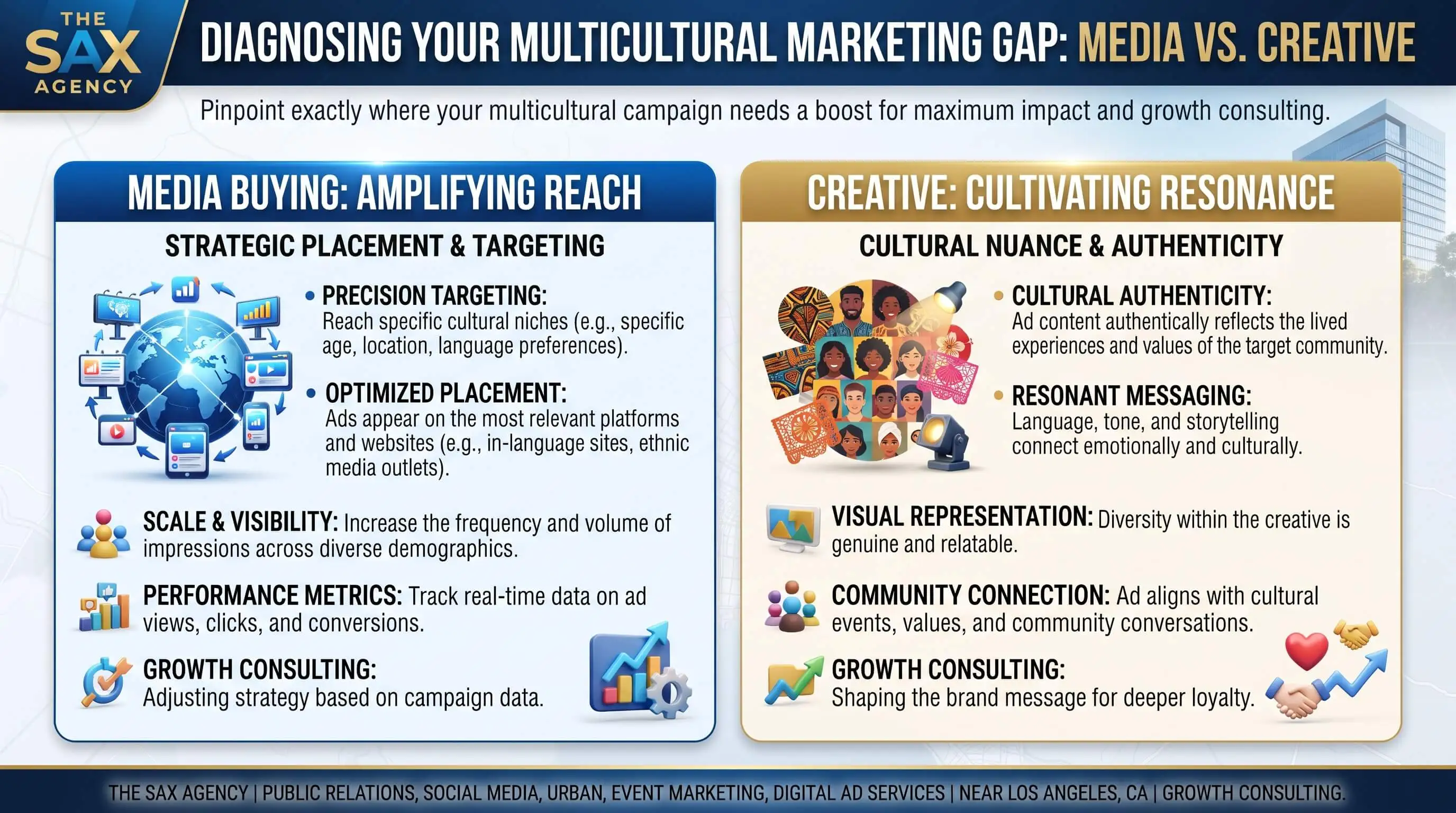
Multicultural media buying decides where, when and how often your message reaches a community. Multicultural creative decides whether that message means anything once it arrives.
The word "multicultural" covers many minority groups, and each one brings its own languages, media habits and cultural references. A Korean American family in Koreatown and a second-generation Mexican American student in East LA do not scroll the same feeds. Neither does a Black small-business owner in Inglewood. One campaign rarely fits all of them, which is exactly why you need to know which side is falling short.
Media buying
What it controls: channels, placements, timing, frequency and media partners, including in-language and diverse-owned outlets
What failure looks like: the right people never see the work, or they see it too rarely to remember it
What success looks like: steady, efficient reach inside the communities you are targeting
Metrics to watch: reach and frequency by segment, cost per reach, and the share of spend going to culturally relevant media
Creative
What it controls: concept, language, casting, cultural cues, storytelling and transcreation
What failure looks like: people see the work and keep scrolling, or they sense it was made for someone else
What success looks like: engagement, shares, brand lift and purchase intent within those communities
Metrics to watch: engagement and click-through by segment, brand lift, sentiment and conversion
Signs Your Multicultural Marketing Needs Creative First
Your team translated the ads instead of transcreating them. The words are correct, yet the feeling disappeared somewhere between English and Spanish, Tagalog or Vietnamese.
Your general-market ads run unchanged in multicultural placements. A spot on a Black-owned podcast or a Spanish-language station does little if the ad itself ignores the people listening.
Reach is on target while response lags. Healthy impressions in your target segments, paired with weak engagement, click-through or brand lift, point straight at the message.
Community feedback calls the work generic. Comments such as "off-key," "stereotyped" or "this is not for us" signal a creative gap rather than a media gap.
Nobody on your team comes from or works inside the community you are entering. Start with cultural insight and creativity before you scale spend.
Signs Your Multicultural Marketing Needs Media Buying First
The creative tests well, but too few people see it. Small tests and community feedback come back positive while distribution stays thin.
Nearly all of your spend sits on the big general-market platforms. In-language and diverse-owned outlets often reach people those platforms miss, and their audiences tend to trust them more.
Frequency stays too low to build recall. One or two exposures rarely change how a community sees a brand.
You have diverse-media spending goals and no plan for meeting them. Many advertisers look for Minority Business Enterprise (MBE) certification when they plan diverse-owned media, so knowing which partners qualify saves time.
Your reports cannot show results by segment. When every audience lands in one blended number, you cannot tell where your media works and where it does not.
When You Need Both at the Same Time
Certain moments call for fixing both sides together. A launch into a new community is one. So is a brand repositioning, a cultural moment such as Lunar New Year, Juneteenth or Día de los Muertos, or the recovery after a cultural misstep.
Order still matters, even then. Media weight cannot rescue a message that feels irrelevant, and strong creative cannot perform if nobody sees it. Fix the message first and test it inside the community. Then put a serious budget behind the version that works.
A Five-Minute Diagnostic: Message Problem or Media Problem?
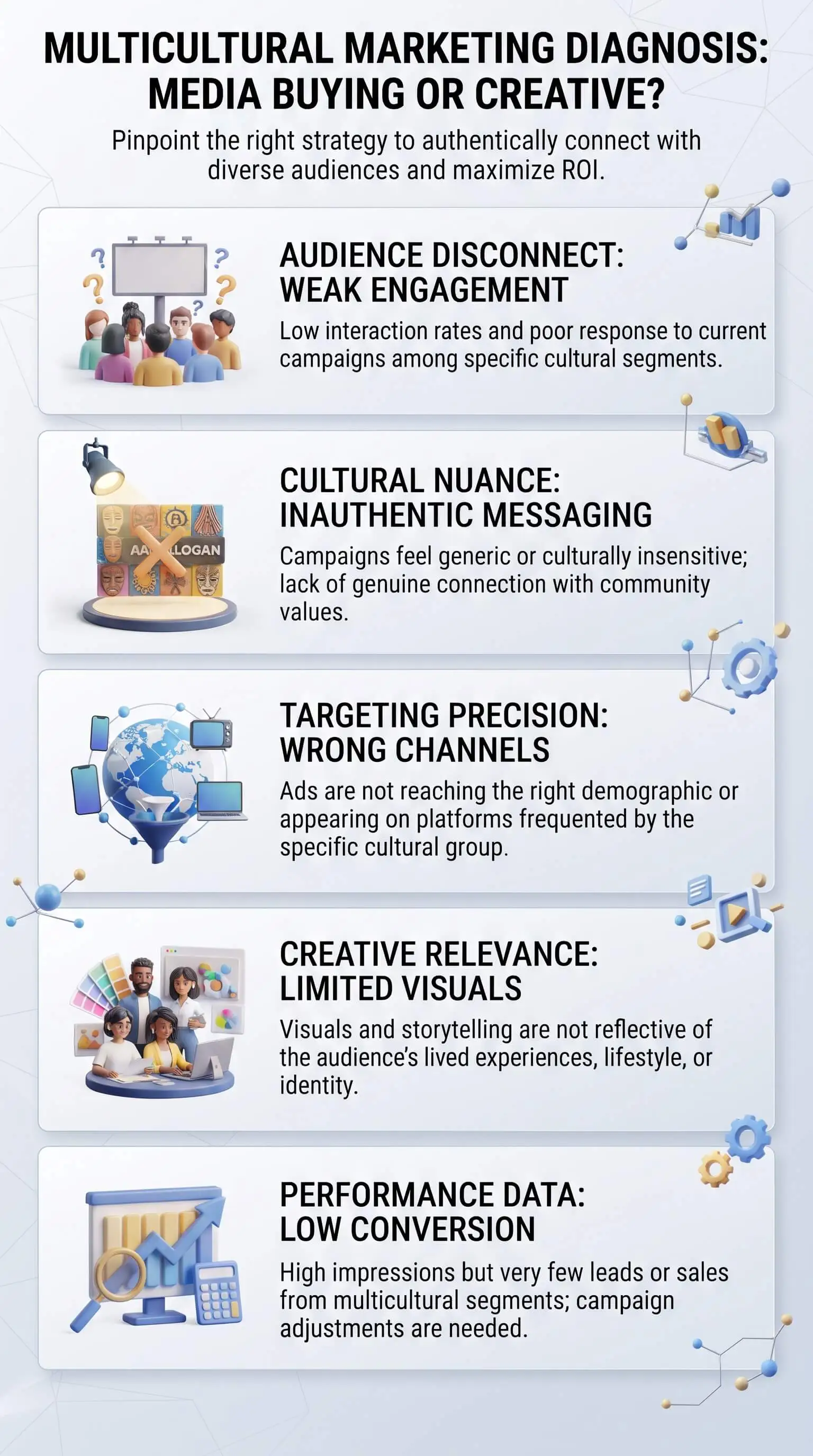
Pull your last campaign's results by segment and look for the sign that matches what you see.
High reach in target segments, low engagement: most likely a creative gap. Transcreate your key assets and test them again with community members.
Strong test results, low reach: most likely a media gap. Add in-language and diverse-owned placements.
Good early engagement that fades over time: most likely a frequency gap on the media side. Lengthen the flight and raise frequency in your core outlets.
Negative or "not for us" comments: most likely a creative gap. Bring in creative talent from inside the culture and review casting and cultural cues.
The same ad running everywhere without changes: most likely a creative gap. Build a version of the core idea for each segment.
Spend concentrated on one or two platforms: most likely a media gap. Add culturally relevant media partners to the plan.
No reporting by segment: a measurement gap. Set up segment-level tracking before you add budget.
The same pattern comes up again and again. Many brands that believe they have a media problem actually have a message that never felt like it was made for the people seeing it.
What Top Multicultural Marketing Agencies Do Differently on Each Side
The strongest partners hold off on selling you a service until they understand your gap. In practice, that looks like this.
On the Creative Side
Creative teams from inside the culture. The people shaping the work share or deeply understand the audience's culture, something a translator alone cannot supply.
Transcreation built into the process. The agency adapts each idea for meaning, humor and emotion instead of converting it word for word.
Community testing before launch. Members of the community review the work before any media dollars go behind it.
Creator and influencer relationships. Trusted micro, macro and niche voices help a message feel native to the community.
On the Media Side
Relationships with in-language and diverse-owned outlets that go beyond the default platform buy.
Measurement by segment, so you can see what works in each community instead of reading a blended average.
Candid advice on reach versus relevance. A good partner will tell you when more spending will not fix a message problem.
Questions to Ask Before You Hire
Who on your team comes from, or works inside, the communities we want to reach?
Do you transcreate our work or translate it?
How do you test creativity with the community before launch?
How will you report results by segment?
Which in-language or diverse-owned media partners do you recommend, and why?
Can you show us a time you changed the creative instead of the media, or the other way around, and what happened as a result?
"When a brand comes to us asking for more reach, we start by looking at how the community already reacts to the work. Most of the time, people have seen it. It simply did not sound like them. Over the years we have learned that cultural roots carry a campaign, because they give the media plan something worth amplifying. So we fix the message first and test it with the people it is meant for. After that, every dollar behind it works harder. We view diversity as a true asset, and audiences can tell when a brand treats it that way."
7 Essential Resources
The Sax Agency: Multicultural Marketing in Los Angeles: a minority-owned agency's perspective on cultural sensitivity, transcreation, influencers and inclusive brand building, with strategy, creative, PR, social and event marketing under one roof.
Wikipedia: Minority group: a clear primer on how minority groups are defined, useful for anyone still treating "multicultural" as a single audience.
ANA: Driving Brand Growth Through Cultural Relevancy: research from the Alliance for Inclusive and Multicultural Marketing on how cultural relevance in ads drives sales and trust.
Marketing Dive: ANA Debuts Measurement for Cultural Impact of Advertising: background on the Cultural Insights Impact Measure (CIIM) and what it found about purchase intent.
Nielsen: Winning for the Long Term, Investing in Diverse-Owned Media: the case for putting diverse-owned media in your plan, and how measurement is catching up.
VAB Multicultural Marketing Agency Directory: a searchable list of multicultural-focused agencies by discipline and location.
Translated: Transcreation vs. Translation vs. Copywriting: a practical guide to deciding when your creative needs adapting rather than converting.
3 Statistics
Cultural relevance drives most of an ad's impact. The ANA's AIMM attribution analysis found that culture and DEIB in ads explain 66% of ads' sales lift and 89% of brand trust lift. (ANA)
Relevance turns into first purchases. In a CIIM survey of 10,000 people, consumers who saw ads as culturally relevant were 2.7 times more likely to buy from a brand for the first time. (Marketing Dive)
Media spend still trails the audience. Nielsen reported that in Q1 2025, online retailers spent less than 1% of their digital ad budgets on Spanish-language websites. (TheDesk)
Read together, the numbers point in both directions. Culturally relevant creative does most of the work, and many brands still underfund the media that would put that creative in front of the people it was made for, highlighting the importance of working with a digital marketing agency that understands both cultural relevance and media allocation.
Final Thoughts and Opinion
Our position is simple. Most brands should fix the message before they scale the media.
The exception, proven creative that is simply not reaching people, comes up less often than most marketers assume. Weak results feel like a reach problem because buying more media feels like action. When the message does not feel made for the community, though, more impressions only repeat the miss.
Media buying and creative work best as a sequence rather than an either-or choice. Diagnose the weaker side and fix it, test inside the community, and then scale both together. The top multicultural marketing agencies work this way because it protects your budget along with your standing in the communities you hope to earn.
Your audiences can no longer be boxed into simple categories, and your marketing should not be either.
Frequently Asked Questions
Do I need a multicultural agency, or can my general-market agency handle it?
It depends on who does the work. Your current agency may be enough if its team members come from or work inside the communities you are targeting and it transcreates instead of translating. If your multicultural work consists mostly of translated versions of your main campaign, a specialist will usually close the gap faster.
What does a multicultural media buyer do that a regular media buyer does not?
A multicultural media buyer plans past the default platforms, into in-language outlets, diverse-owned media, community publishers and creators who hold the trust of specific audiences. The buyer also plans and reports by segment, so you can confirm you are reaching each community instead of relying on a blended average.
Can I just translate my existing ads for multicultural audiences?
You can, although results usually suffer. Translation swaps words. Transcreation adapts the idea, the humor, the emotion and the cultural cues so the ad lands the way it was meant to. Ads that only go through translation often come across as stiff, off-key or plainly made for someone else.
How should I split my budget between media and creative?
No universal ratio exists. Fund the weaker side first. If nobody has tested your creativity with the community, put an early budget into insight, transcreation and testing. Once the work performs, move more budget into media to build reach and frequency, then rebalance based on your results by segment.
How do I measure whether my multicultural creative is working?
Track engagement, click-through, brand lift, sentiment and conversion by segment instead of across all audiences at once. Run different creative versions in the same placement and compare them. When one version clearly outperforms the others inside a community, that creative is doing its job.
What should I look for when comparing top multicultural marketing agencies?
Look for creative talent from inside the culture, a working transcreation process, community testing before launch, relationships with diverse-owned and in-language media, and reporting by segment. Ask each agency for an example of a campaign where it changed the creative rather than the media, or the reverse. The answer shows you how the agency thinks.
Ready to Find Out Which One Your Brand Needs?
If you cannot tell whether your multicultural marketing has a message problem or a media problem, there is no need to guess. A multicultural team from a polycultural marketing agency that understands both culture and channels can review your current campaign, pinpoint the gap and help you build work that feels true to the communities you want to reach.
Please feel free to reach out and connect with The Sax Agency to start the conversation.